
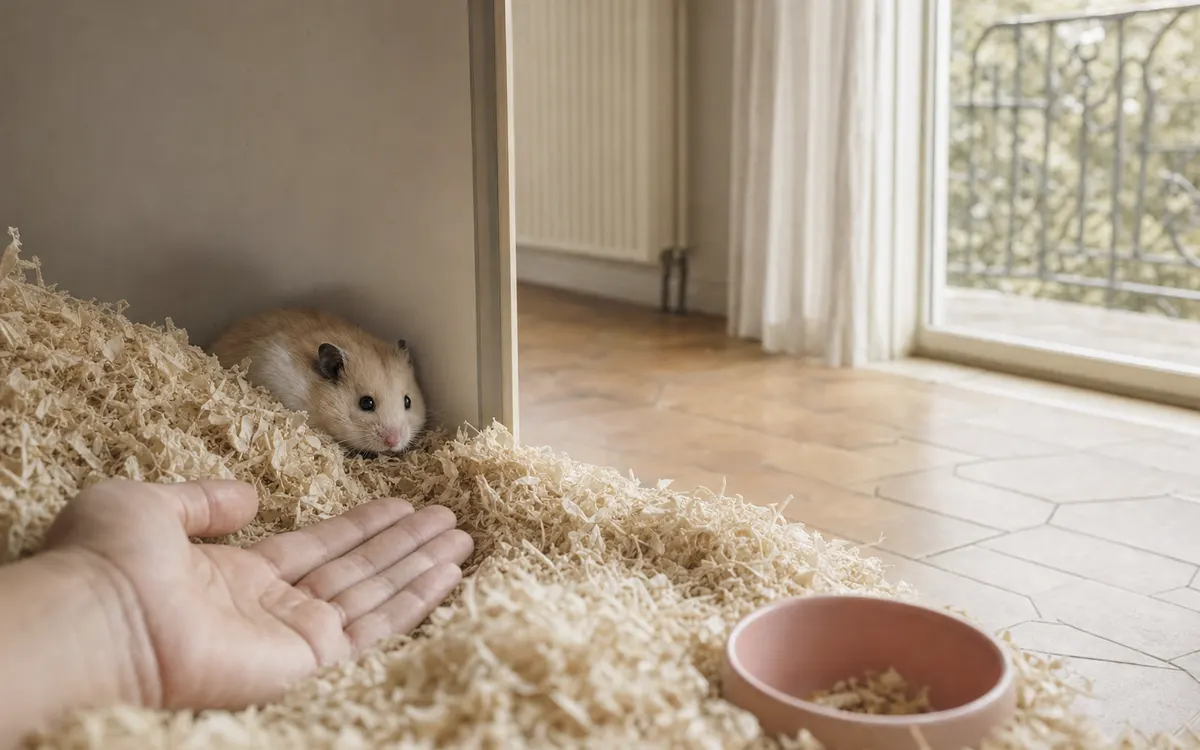
It is the most common complaint from first-time hamster keepers: “it is aggressive, it bites”. That description is wrong, and it leads to the wrong solution, because a hamster that bites is almost never attacking. It is warning you, after having warned you in four other ways that went unnoticed.
What Kind of Animal We Are Talking About
A hamster is a nocturnal prey animal that lives in burrows. Its defensive repertoire is short: hide, freeze, flee and, when none of the three is available, bite.
Add three things that explain most household bites:
- It sees poorly. Hamster eyesight is weak. It navigates by smell and hearing, so a hand appearing with no warning is literally an unknown object.
- It sleeps during the day. We interact in the afternoon and mid-morning, which is when it sleeps. Waking a prey animal abruptly is the perfect recipe.
- A hand from above is predator-shaped. It is the exact angle a bird of prey arrives from. Lowering a hand vertically over the animal triggers the defence response before any reasoning gets a chance.
The Chain of Warnings
Almost no bite is the first step. Before it, in this order, you usually get:
- Total stillness. It freezes. This gets read as “it is calm” and it is precisely the opposite.
- Turning the head towards the hand, tracking it closely.
- Rearing up with front paws raised. A clear defensive posture.
- A high-pitched squeak. The explicit warning.
- An escape attempt towards a hide or into a corner.
- The bite.
If you withdraw your hand at step 1 or 2, the hamster learns its signals work and does not need to escalate. If you push through to step 6, it learns the opposite: that only biting makes you leave. That is exactly how a hamster that “bites for no reason” gets built.
The Five Most Common Causes
1. It was woken up. By far the most frequent. A hamster lifted out of its nest at five in the afternoon is not being rude: it is disoriented and frightened. Interact at dusk, when it comes out by itself.
2. The hand smells of food. If you have just handled seeds, fruit or anything edible, your fingers smell of food and the animal sees badly. That bite is not defence, it is a mistake. Wash your hands first, every time.
3. Lack of early handling. Hamsters that were not handled calmly in their first weeks need much longer to habituate. It is not irreversible, but it takes patience.
4. Pain. This is the important one. A hamster that never bit and suddenly does has not changed personality: something probably hurts. Impacted cheek pouches, abscesses, dental problems, tumours, a leg injury. That is a reason to see a vet, not to do behaviour work.
5. Space and chronic stress. A small cage with no deep bedding to burrow in, no hides, constant noise or heavy foot traffic produces a permanently alert animal. A stressed hamster has a far lower threshold for defence.
How to Rebuild Trust
The goal is not “getting it used to being picked up”. It is making it associate your hand with something good, with contact being its decision. The phases are these, and each lasts as long as it needs to:
Phase 1: exist without touching. Several days. Sit near the cage at dusk and talk quietly. Let it get used to your smell and voice with nothing else happening.
Phase 2: the still hand. Rest your open hand inside the cage, on the floor, without moving it and without chasing. Let it approach you. It can take several sessions. Do not touch it when it comes over, tempting as that is.
Phase 3: food in the hand. Offer a sunflower seed or a piece of its favourite treat on an open palm. Let it climb up to take it. The golden rule here is never to close your hand.
Phase 4: climbing on. With the hand resting flat, let it climb on to take the food. No lifting. Repeat until it is routine.
Phase 5: lifting. Only once the previous step is solid and boring. Lift a few centimetres, briefly, with both hands forming a bowl and always close to a surface, because hamsters launch themselves and falls are a serious problem.
Rules throughout: sessions of three to five minutes, daily rather than long and occasional; always at dusk; never wake it; never bring a hand from above, come in from the side; and always end before it gets tired rather than once it has had enough.
If there is a bite one day, the answer is not blowing on it, a tap on the nose or shouting. It is calmly withdrawing your hand and going back one phase. Punishing a prey animal only confirms that you meant harm.
What to Do About the Bite Itself
Holding still through a bite without withdrawing the hand is a piece of advice that circulates and is a bad one: as well as being painful, it teaches the hamster that biting hard works better than biting softly.
As for the wound: wash with soap and water, disinfect and watch it. Incisors make narrow deep punctures that close on the outside before the inside, so if at 24 or 48 hours there is spreading redness, heat, pus or increasing pain, see a doctor.
The Shift in Perspective That Solves It
Stop asking why it is aggressive and start asking what it finds dangerous. The answer is almost always one of three things: you are waking it up, the hand arrives from above, or the animal lives in a space that never lets it relax.
Fix those three and the biting, in most cases, disappears on its own.