
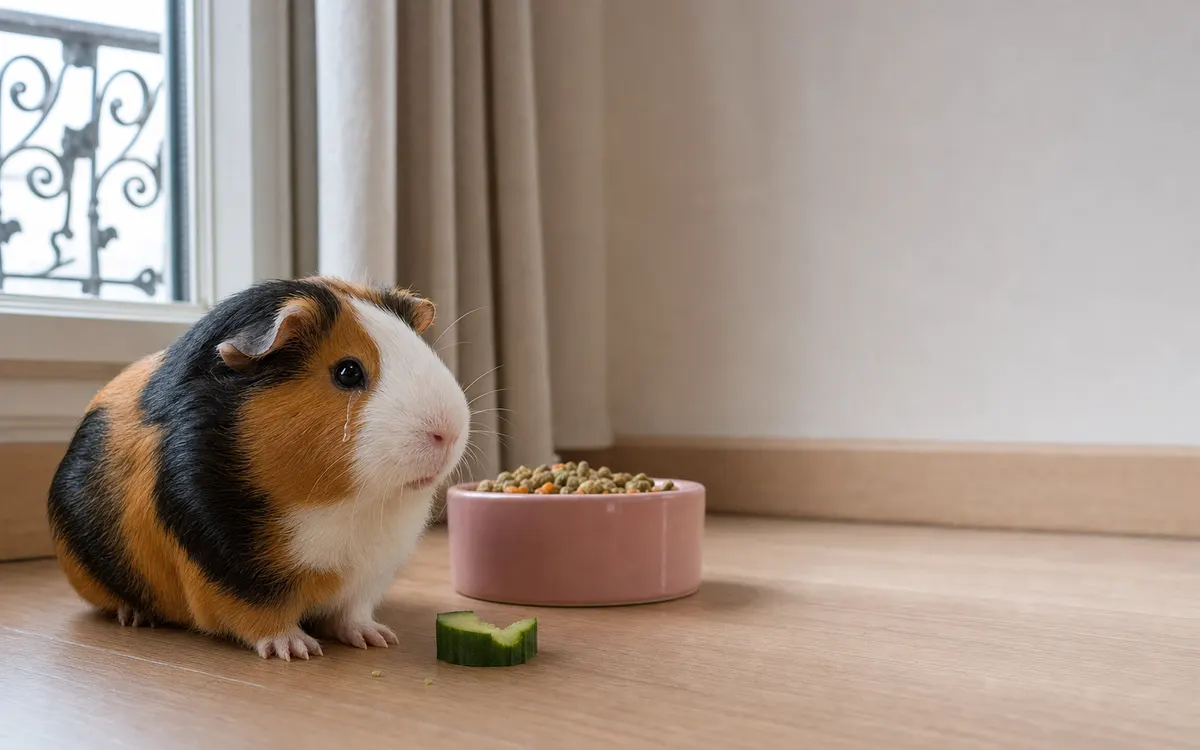
It is the most common health problem in rabbits, guinea pigs and chinchillas, and also one of the latest to get diagnosed. The reason is simple: when the owner looks in the mouth, they see two perfect front teeth and relax. The problem is further back, where the eye cannot reach.
Rodent teeth do not work like ours. Understanding that difference explains almost everything else.
A Tooth That Never Stops Growing
In a rabbit, a guinea pig or a chinchilla, every tooth grows continuously. There is no closed root: they grow from the base for the animal’s whole life, at two or three millimetres a week.
That works because in the wild these animals spend most of the day chewing grass and fibrous plants, an abrasive material that demands a sideways jaw movement. That movement wears the cheek teeth evenly and keeps their length in check.
At home, with a bowl of concentrated pellets, the animal is full in ten minutes. It eats, yes, but it chews a fraction of what it should, and chewing pellets is a more vertical motion than a grinding one. The teeth keep growing at the same rate. The wear does not.
In rats, mice and hamsters the situation differs: the incisors grow for life, but the molars have closed roots. In those species problems concentrate in the front teeth, usually from a misalignment that stops them meeting each other.
Uneven Wear Is What Does the Damage
When wear fails, the teeth do not simply get longer in a tidy way. They wear unevenly and develop sharp spurs on the edges: towards the tongue on the lower arcade and towards the cheek on the upper one.
Those spurs cut. They cause ulcers on the tongue and the inner cheek that hurt when chewing. And the animal, unable to say so, starts eating differently to avoid the pain: it picks soft food, chews on one side only, eats more slowly, abandons hay and sticks to pellets, which is exactly what makes the wear worse. The circle closes.
Meanwhile, the part of the tooth that cannot emerge upwards has to go somewhere, and it goes inwards. The roots of the upper molars push towards the eye socket and the tear duct. The lower ones push towards the edge of the jaw, where they can sometimes be felt as small hard lumps.
The Signs That Appear Before Anything in the Mouth
This is the important part, because by the time the animal stops eating, the process has been running for months:
Drool or wet fur under the chin. The classic sign in guinea pigs and rabbits. If the throat area is permanently damp or matted, swallowing hurts.
A watery eye with no infection. Explained above: an upper molar root compressing the tear duct. That calls for an X-ray, not eye drops.
Selective feeding. Eats pellets but leaves the hay. Eats the soft part of the vegetable and leaves the stalk. Takes far longer than it used to.
Smaller or fewer droppings. In rabbits and guinea pigs the gut depends on a continuous flow of fibre. Less chewing means less fibre, and that shows up in the litter tray before it shows on the face.
Lumps along the jawline. Felt by running a finger along the bone and comparing both sides. One side fuller than the other means a molar root growing downwards.
Slow weight loss. Hard to spot under fur. Weighing the animal once a month on a kitchen scale is one of the most useful and cheapest things you can do, and it turns a suspicion into a number.
New apathy or grumpiness. An animal with chronic mouth pain stops letting you touch its face and can turn snappy. It gets blamed on personality and it is pain.
What Actually Prevents This
Only one thing, and it is not an accessory: unlimited hay, permanently available, as the base of the diet.
In a healthy rabbit or guinea pig, hay should be around 80 per cent of what they eat. Not a handful a day as a supplement: a pile the size of their own body, refreshed daily, available at any hour. It is the only thing that generates the hours of grinding that wear the cheek teeth down.
Pellets are the opposite of that. A good pellet has its place as a vitamin source, especially vitamin C in guinea pigs, which cannot make their own, but the correct amount is small: one or two tablespoons a day for an adult rabbit, not a full bowl. Muesli-style mixes with coloured cereal, seeds and crunchy bits are worse still, because the animal picks out the sweet parts and leaves the fibrous pellets.
Chew sticks and mineral blocks are sold as a dental solution and they are not. They help with enrichment and with the incisors, but the serious problem is in the cheek teeth, and they never get there.
What the Vet Does, and What You Should Not
A full diagnosis needs skull X-rays and an oral examination with a gag and, in most cases, sedation. The reason is physical: with an otoscope and an awake animal you see the front of the arcade, not the back, and the problem is usually at the back.
Treatment means burring the spurs down with rotary instruments. It is a routine and well tolerated procedure.
What must never be done is clipping the incisors with pliers at home. The tooth splits vertically, the fracture can reach the pulp, and abscesses follow that are a far worse problem than the original one.
One note on urgency: in rabbits and guinea pigs, not eating for more than twelve hours is a genuine emergency, not something to look at tomorrow. Their digestive system stalls when fibre stops arriving, and gut stasis kills quickly.
What to Take Away
Rodent teeth do not go wrong overnight. They go wrong over months of a diet that is too soft, and they warn you well in advance with signs that do not look dental at all. A permanently damp chin, a watery eye, an untouched pile of hay and a falling weight are better indicators than looking at the incisors, which are almost always perfect.