
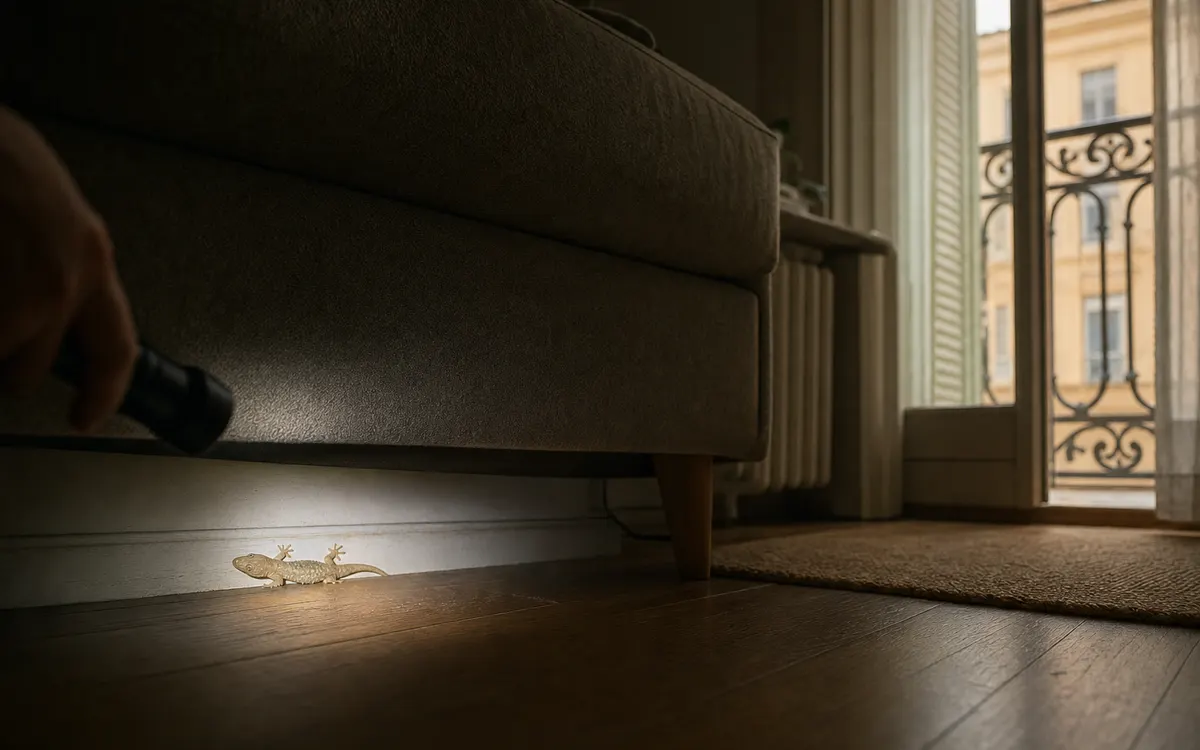
An escaped reptile produces a very particular kind of anxiety, because the animal is silent, hides by instinct and does not answer to its name. The good news is that escapes follow highly repetitive patterns, both in the point they leave through and in where they end up.
Where They Actually Get Out
It is almost never a wide open door. It is these five points, in order of frequency:
1. The lid after cleaning or feeding. The number one cause by a distance. You open it to refill water or offer food, the phone rings, you leave it resting. A leopard gecko needs less than a minute.
2. The cable entry. The gap where the heat mat cable, the thermostat probe or the lamp cable enters is a hole perfectly sized for a small reptile. And because it is round the back, nobody looks at it.
3. Sliding door runners. Glass enclosure sliders rarely close fully unless pushed all the way, leaving a gap of a few millimetres at one end. For a young snake or a crested gecko, that is a door.
4. The ventilation mesh. It loosens over time, especially if the animal pushes at it or climbs on it. One lifted edge is enough.
5. The top lid with no weight. Snakes push upwards with a strength that surprises everyone the first time. A lid that merely rests in place is not a closure.
How a Loose Reptile Thinks
This is what makes it findable, and it is surprisingly predictable:
It looks for heat. It is an ectotherm outside its thermal gradient. Its absolute priority is finding a heat source. That is why they turn up behind the fridge, the freezer, the washing machine, the television or the router: those are a house’s hot spots.
It looks for tight spaces. It feels safe when something touches it from above and from the sides. It does not choose the middle of the room: it chooses the tightest gap available.
It hugs the walls. It travels along skirting boards and edges, not across open floor.
It moves little, and at specific times. Many species move at dawn or dusk and stay motionless the rest of the time. That is why a room you have “already checked” can still contain the animal.
The Search Method
Step 1: close the zone. Before anything else, shut the room doors and block the gap underneath with a rolled towel. If you do not know how long it has been out, do the same in other rooms to shrink the territory.
Step 2: kill the noise. Television, music and fans off. With large lizards and snakes you can sometimes hear movement.
Step 3: the hot spots, in this order. Behind and underneath the fridge and freezer (the motor at the back is the number one location), washing machine and dryer, behind the television and router, radiators, and behind furniture against a sunny external wall.
Step 4: dark gaps at floor level. Under low furniture, inside shoes and boots, among the books on the bottom shelf, inside storage boxes, and very particularly inside the underside of the sofa, which is a place almost nobody checks because it means lying on the floor.
Step 5: moisture. Under the sink, behind the toilet, in the boiler cupboard. Important for tropical species.
Step 6: the flour trail. Dust an extremely thin layer of flour or cornflour across doorways and along skirting boards. It is not a trap: it is a direction detector. Check first thing in the morning.
Step 7: heat as bait. Put a heat mat under an improvised hide, such as an upside-down cardboard box with an entrance cut out, on the floor of the suspect room. This works better than anything else: you are offering exactly what it is looking for.
Precautions While the Animal Is Loose
This matters as much as the search:
- Tell everyone in the house. Nobody moves heavy furniture, nobody vacuums, nobody slams doors.
- Watch the doors. A reptile in a door frame as it closes is a serious injury.
- Other pets. Cats and dogs into another room for the duration.
- Before running the washing machine, look inside the drum and behind it.
- Do not leave open containers of water it could fall into and not climb out of.
Prevention, Where the Real Win Is
Once recovered, half an hour of work prevents the next scare:
A real closure, not a resting one. A lock or catch on sliders. On top lids, locking clips or enough weight, bearing in mind a snake pushes far harder than it looks.
Seal the cable entry with heat-resistant material, letting the cable through with no slack.
Check the ventilation mesh inside and out, pulling gently at the corners.
A process rule. This one prevents half of all escapes: never open the enclosure and leave the room, not for a second. If you have to go, close it first.
Weekly check. During maintenance, run your hand around the whole perimeter looking for play. Enclosures shift with use and with heat cycles.
If It Does Not Turn Up
Do not give up early. It is very common for a reptile to appear after three, five or ten days, sometimes in a room checked several times, simply because it moved.
Keep the flour trails, leave the heated hide out every night and check first thing.
And when you find it, before returning it to the enclosure: check for injuries, offer water and let it warm up gradually on the warm side. If it has been out for several days it has been cold and dehydrated, and a visit to an exotics vet is a good idea even if it looks fine.