
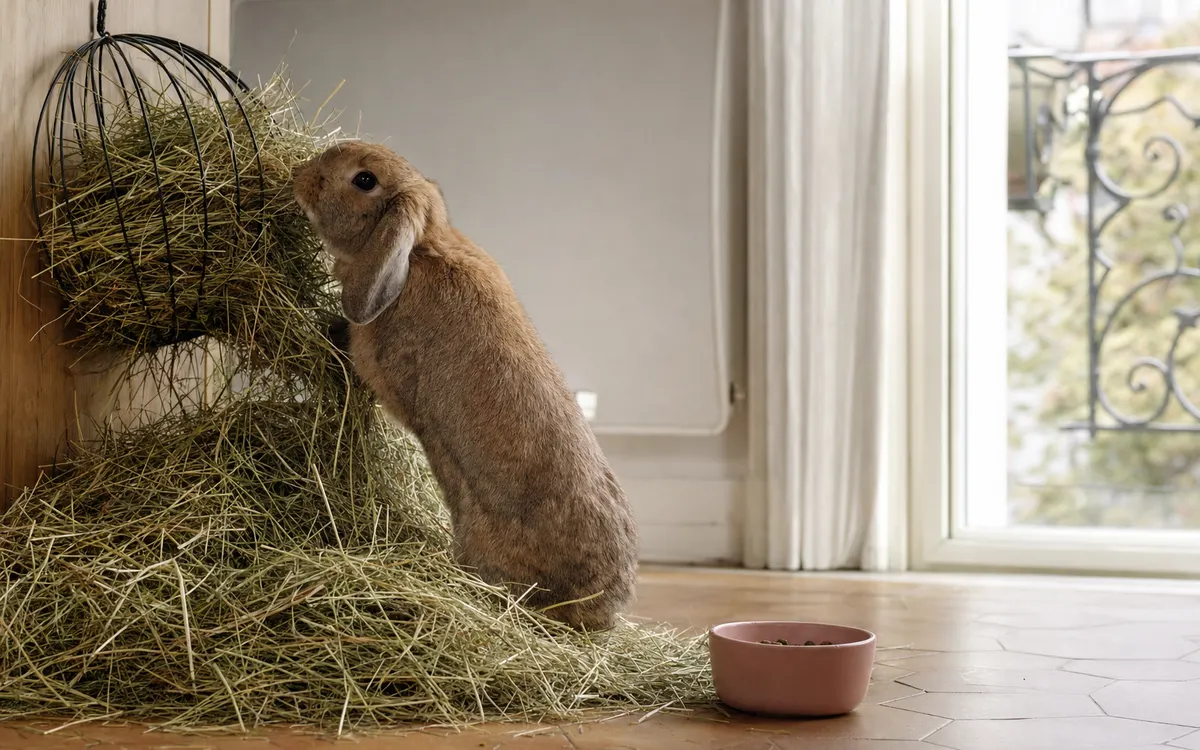
Ask anyone in the street what a rabbit eats and almost everyone will say carrots. Look at most pellet packaging and it will seem the diet is built on pellets. Both answers are wrong, and that confusion sits behind a large share of the digestive and dental problems seen in veterinary practice.
The correct diet for a pet rabbit fits into one ratio, and that ratio is fairly counterintuitive.
The Ratio, in Order of Importance
- Hay: around 80%. Unlimited, always available, all day.
- Leafy greens: a generous handful a day, rotating varieties.
- Pellets: one or two tablespoons a day, not a bowl.
- Fruit, carrot and treats: occasional reward, not diet.
In other words: what most people think of as “rabbit food” (the pellets) is actually the least important ingredient, and what many see as cage bedding (the hay) is the essential one.
Why Hay Is Not Optional
A rabbit has two particularities that explain everything.
Its teeth grow throughout its life. Not a little: continuously. The only thing that keeps them at the right length is chewing long fibre for hours, which is exactly what hay provides. A rabbit eating mostly pellets chews for a short time and its teeth grow badly, developing spurs that cut its tongue and cheeks. Dental problems in rabbits are common, painful and expensive to treat.
Its gut has to keep moving. A rabbit’s digestive system runs on a constant flow of fibre. When that flow is interrupted, transit slows or stops, and that is a genuine emergency, not an inconvenience.
That is why hay is not “bedding” or an extra: it is the pillar of the diet and must be available around the clock, in quantity, and refreshed often so it smells good and stays appetising.
Pellets: Less Is More
Pellets are not bad, but they are designed as a supplement and used as a base. The problem is simple: they are dense, tasty and filling. A rabbit with a full bowl fills up on pellets and eats less hay, which is exactly the opposite of what it needs.
One or two tablespoons a day for a healthy adult is usually enough. And if you have to choose, a plain fibre-based pellet beats a muesli mix with coloured seeds, dried fruit and flakes: in those mixes the rabbit picks out the sweet bits and leaves the boring ones, which were precisely the useful part.
Vegetables: Variety Over Quantity
A daily handful of leafy greens provides water, micronutrients and variety. Lamb’s lettuce, rocket, endive, escarole, celery, basil, coriander and carrot tops all work well, and the tops are better than the carrot itself.
Two practical rules:
- Rotate. Three or four different types across the week beats one type in large amounts.
- Introduce slowly. Each new vegetable in small quantity and on its own, to see how it agrees before adding it in.
And carrot and fruit go where they belong: a small, occasional treat. The image of the rabbit with a carrot is cultural, not nutritional.
Water
Always available and clean. A bottle drinker is convenient for us, but many rabbits drink considerably better from a heavy bowl, in a natural posture. If your rabbit drinks little, try changing the format before assuming it is just how they are.
The Warning Signs
Rabbits are prey animals and hide discomfort until they cannot. These signs call for a vet the same day:
- Smaller, misshapen or far fewer droppings than usual.
- Several hours with no droppings at all.
- Refusing food, even food it likes.
- Sitting hunched and still, pressing its belly to the floor.
- Loud, continuous tooth grinding.
In a rabbit, not eating is not a passing mood: digestion stalls and the situation worsens in hours, not days.
What Changes With One Adjustment
If your rabbit eats a lot of pellets and little hay, the change is not made abruptly: reduce the pellets gradually over a couple of weeks while offering fresh, varied hay in abundance. Many rabbits that “won’t eat hay” simply have a full pellet bowl available all day.
Adjusting that ratio is the cheapest, highest-impact intervention there is in rabbit care. And as with any health topic, if there are doubts or symptoms, the consultation is with a vet experienced in exotic animals, not with a forum.