
There is one very specific moment every cat owner with a balcony knows: you step out for a second to hang the washing, you turn round, and your cat is up on the railing, working out the distance to the balcony opposite or looking down with that curiosity that makes a human's hair stand on end. That second of panic is what sends many people looking for a cat net, and the problem shows up right afterwards: you are renting, or you simply don't want holes in a façade that isn't yours, and you don't know whether a solution exists that doesn't involve drilling.
The PetsLovers no-drill cat net is designed for exactly that: closing the gaps in your balcony, terrace or window using tension and mechanical fixing systems, without touching the wall or the railing with a single screw. It is a reversible installation, meant for you to fit yourself in a short time and, if you ever move out, to take down without leaving a trace. That said, let's be clear from the start: no net, drilled or not, eliminates risk 100%. It hugely reduces the chance of a fall or an escape, but it doesn't replace supervision and it doesn't turn the balcony into a space where you can stop paying attention altogether.
Why Choose the No-Drill Option
Drilling isn't the problem in itself, it is everything that comes after it: asking the landlord for permission, leaving marks you then have to repair before you leave, or simply not being allowed to do it if you live in a listed building or under a strict residents' association. The PetsLovers no-drill net removes that blocker with tension systems and pressure anchors that adjust to the balcony itself, needing no holes in the wall or the railing.
It is the natural option if:
- You are renting and want to avoid any permanent modification.
- Your residents' association doesn't allow drilling into the façade.
- You would rather be able to take the net down if you change home, change furniture, or simply change your mind.
- You want to try the solution before deciding whether you would prefer a fixed installation in future.
Who it isn't the best option for
If you have a very large terrace, with awkward corners or surfaces with nothing to tension against (smooth walls with no natural anchor point, for instance), a fixed drilled system may give a firmer result in the long run. The no-drill version performs better the more "ordinary" the balcony structure is: railings, parapets or window frames where the net can be tensioned evenly.
How Fixing Without Holes Works
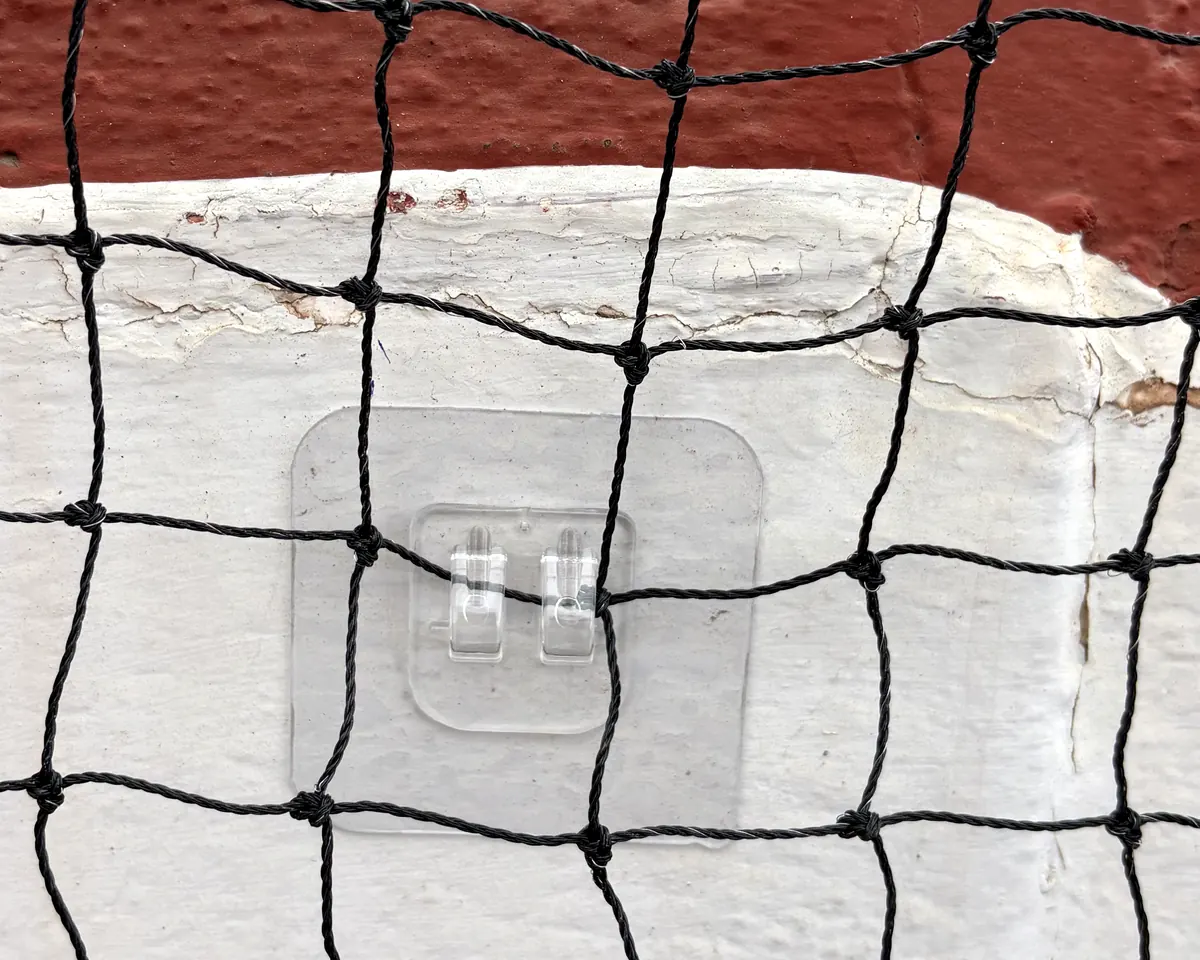
Instead of screws, the installation relies on tensioners, securing cords and anchor points that make use of the balcony's own structure: the railing, the window frame or the sides of the opening. The idea is to spread the net's tension across several points so it doesn't depend on just one, rather like the way a tarpaulin or an awning is rigged without bolting it to the wall.
Standard balconies versus long terraces
For a normal-sized balcony, the 4 × 3 m size usually covers the gap with room to spare, leaving margin to tension it properly. If your terrace is longer or has several runs to close, the 8 × 3 m version lets you cover more surface without joining several small nets, which makes it easier to spread the tension evenly.
Transparent or Black: Does It Change Anything Without Drilling?
The tension system works the same in both finishes, so the choice here is purely aesthetic. The transparent net is the more discreet option if you don't want it noticed from the street or blocking the view; many tenants prefer it precisely because, with no drilling and almost invisible, it is easy to return the balcony to its original appearance when moving day comes. The black net, on the other hand, blends better over dark railings and gives a more discreet finish at a distance if your balcony already has that kind of structure.
How to Fit It Yourself, Step by Step
No previous DIY experience needed. Broadly, the process follows this logic:
- Measure the real gap of the balcony or window (width, height, and whether there are irregular runs) before choosing between the 4 × 3 m and 8 × 3 m sizes.
- Identify the anchor points available: railing, window frame, sides of the opening.
- Fix the tensioners or securing cords at those points, spreading the tension across several areas instead of concentrating it in one.
- Tension the net progressively, checking that no loose gaps are left where a cat could slip through or force its way past.
- Go over the whole thing once fitted, pushing the net with your hand to make sure it doesn't give anywhere.
Tips for a Firm Fit Without Drilling
- Spread the tension points: the more supports you use, the less load each one carries and the more stable the whole thing is.
- Check the tension from time to time, especially after days of strong wind or rain, and readjust if you notice a section has worked loose.
- Don't leave areas without a firm hold at the corners: that is where a cat pushes hardest if it senses a little slack.
- If you have doubts about whether an anchor point will hold well, reinforce it with a second tensioner in that area rather than forcing it.
Even with a well-executed installation, no system, drilled or not, replaces supervision. The net notably reduces the risk of falls and escapes, but it is worth keeping an eye out now and again, especially in the first few days, while you check that the tension stays stable with your cat's daily use.
And What if You Later Want to Move to a Fixed Installation?
Nothing forces you to decide everything on day one. Many owners start with the no-drill version precisely because they are renting or want to test how their cat adapts to having the balcony closed off, and only consider a permanent fixing later, if they buy a place of their own. If you want to compare the two routes in detail before deciding, take a look at the PetsLovers general guide to cat safety nets.
Frequently Asked Questions
Does the no-drill net hold a cat's weight when it jumps or leans against it?
Can I install it in a rented flat without losing my deposit?
What is the real difference between the tension system and drilling into the railing?
Does it work with aluminium, iron or glass railings?
Do I need special tools to fit it myself?
Does it stand up to wind and rain as well as a screwed-in net?
My terrace has several runs and irregular corners, can I close it without drilling?
How do you attach a cat net without drilling?
Does a cat proof balcony without drilling actually hold?
Can you fit a cat net on a window without drilling?
Choose the Net for Your Cat
Available in transparent (almost invisible) and black (modern look), in 4x3 m and 8x3 m. The purchase is completed on Amazon.
A safety net reduces risk but does not eliminate it and does not replace supervision. This content is informative; if you have doubts about the installation, read the product manual or consult a professional.