
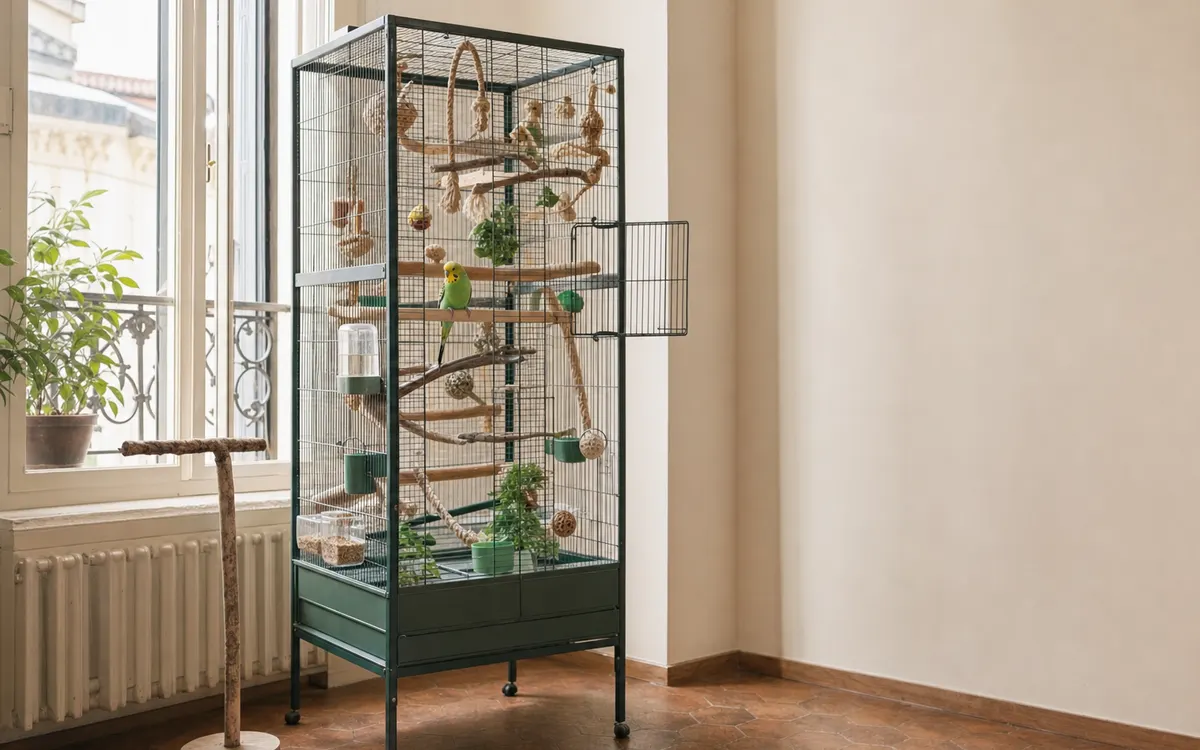
It is the question that always comes up when setting up a bird’s space: if budget and room are limited, is it better to buy a bigger cage or to let the bird out for more hours a day?
The question is framed wrongly, which is why the answers are confusing. The two things do not compete for the same job. One covers the 22 hours a day when you are not there. The other covers the two when you are.
What Each One Solves
The cage solves the baseline. It is where the bird sleeps, eats, preens and spends most of its life. A small cage cannot be compensated for by anything, because the problem is not an afternoon of boredom: it is immobility all day long. A bird that cannot stretch its wings or move around loses muscle and develops joint and behavioural problems.
Out-of-cage time solves the social and exploratory side. That is where the bird genuinely flies, interacts with you, investigates, works out new things. No cage, however large, replaces that in a social species.
Put differently: the cage is the floor and out-of-cage time is the ceiling. If the floor is too low, raising the ceiling fixes nothing.
If You Could Only Fix One Thing
In practice, the more serious and more common failure is the cage, not the hours.
The reason is exposure: an inadequate cage acts 24 hours a day, 365 days a year. One missing hour of flight acts for one hour. On top of that, out-of-cage time depends on your diary, your health and the difficult weeks; the cage is always there.
So if a priority order is needed, it is this one:
- A cage of the right bird cage size and shape.
- Enrichment inside the cage, which is the cheapest and most ignored item.
- As much out-of-cage time as you can give, regularly.
What Makes a Cage Big
It is not the volume in litres. It is three things:
Horizontal length. Birds fly forwards, not upwards. A tall narrow cage is a tube and the bird does not use it. Between two cages of the same total size, always take the one allowing the longest horizontal run. The mental test is simple: can your bird take two or three real wingbeats from one end to the other?
Enough width for the wings. The bird has to be able to open both wings fully without brushing the bars, and turn around with them open.
Suitable bars. Horizontal in climbing species such as parrots, lovebirds and budgies, because they turn the walls into usable surface. And with spacing matched to the bird’s size: too wide and it can push its head between two bars, which is a serious and entirely preventable accident.
A note on shape: round cages are still sold and still poor. They have no corners where a bird can feel sheltered, and the curved geometry makes it hard to fit useful perches.
What Almost Nobody Does: Enrich the Inside
This is where the return per euro is best, and it is the part everyone skips.
Perches of varied diameters and materials. The standard plastic perches, all the same thickness, force the foot into one posture all day and encourage foot lesions. Natural branches of different calibres, safe for birds, change that completely.
Perches placed to create journeys. Not all at the same height or in a line. The idea is that the bird has to travel from the food to the water and on to the sleeping spot.
Toys that get destroyed. Paper, soft wood, cardboard, natural fibre rope with no loose threads. Chewing and shredding is a need, not a whim, and a bird that does not do it to a toy ends up doing it to its feathers.
Weekly rotation. A toy that has been in place for three months is no longer a toy: it is furniture. Keep two or three sets and alternate.
Foraging. Instead of a full food bowl, hide part of the ration in puzzle feeders, in crumpled paper, among branches. In the wild, finding food takes up much of the day; in a cage it takes four minutes. That gap is what problem behaviours fill.
How to Make Out-of-Cage Time Count
One well-designed hour beats three with the bird perched on the back of a chair.
- Give it a destination. A perch gym, a high area with toys, somewhere where something happens. If there is nothing better outside the cage than inside it, the bird will not explore.
- Make sure there is flight. The point is wingbeats, not just walking across the sofa.
- Make it safe. Windows and mirrors covered or marked, fans off, non-stick pans not in use, toxic plants away, and other household animals in another room. Pet birds have their accidents almost entirely indoors.
- Make it regular. Two short daily sessions beat one long weekly one.
When the Answer Is Clearly One or the Other
Prioritise the cage if: you have a cat or dog and free flight is hard to organise, you work long hours away, the bird spends most of the day alone, or your current cage does not allow full wing extension.
Prioritise out-of-cage time if: you already have a spacious well-equipped cage, your bird is a highly social species such as a medium or large parrot, or you are seeing boredom signals like repetitive screaming at the same hour or early feather chewing.
The Short Answer
If you can only spend once, spend it on the cage, because it works 24 hours a day and does not depend on how your week goes. If that is already sorted, every extra hour outside pays enormously. And in either scenario, half an hour spent hiding the food around the inside of the cage is probably the cheapest and most effective improvement you can make today.