
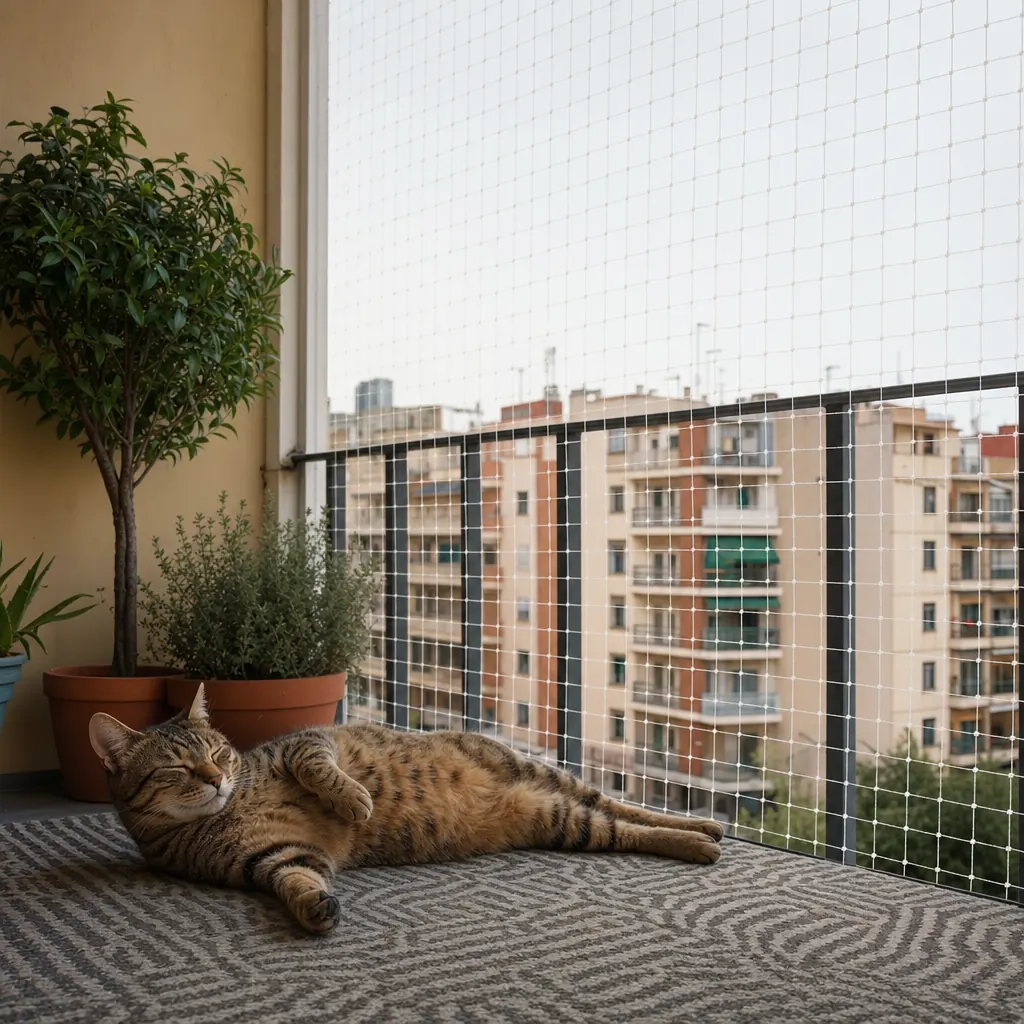
There is one very specific fear almost every cat owner in a flat shares: the miscalculated jump. A cat sees a bird, hears a noise down in the street, spots another cat at the window opposite, and jumps without thinking about the actual drop below. You don't need a balcony for that: a window left ajar on the third, fourth or seventh floor is practically the same risk as an unprotected terrace.
The good news: closing that opening doesn't mean bricking up the window or giving up your light. With a well-chosen, well-fitted net the risk of a fall or an escape drops sharply, you still see the street almost as if nothing were there, and your cat keeps its favourite spot in the sun. It is not a magic solution and it doesn't replace supervision, but it is the most sensible step if your cat has access to open windows.
Why the Window Matters as Much as the Balcony
When we think about a cat net we usually picture balconies and terraces, and we forget the bedroom window, the kitchen window, or the bathroom window left ajar for air. A cat doesn't need a big opening to want out or to lean too far: the gap you open every day is plenty. The more opening windows the flat has, the more risk points there are to check, not just the main balcony.
Window Types and How to Adapt the Net to Each
Not every window closes the same way, so before you think about fitting, look at which type you have.
Tilt-and-turn windows
This is the most common type, and also the one most often left in tilt mode for ventilation without being fully opened. The net goes on the outside of the opening and covers the entire frame, so it doesn't matter what position the sash is in: the cat meets the barrier before it reaches the drop.
Sliding windows
Here the challenge is that the sash slides horizontally, so the free opening changes depending on how far it is open. The solution is to cover the complete frame, not just the part that happens to be open, so the protection works however wide the window is pulled back.
Windows with a sill or outside ledge
If your window has a wide sill outside, experience says the cat will climb onto exactly that, right to the edge. In that case the net should be well tensioned from the frame itself, with no slack, so no uncovered stretch is left between the glass and the outside.
How to Measure the Opening Before Buying
Before choosing a size, measure the width and height of the outer window opening, not the glass, but the complete frame the net will be anchored to. It is also worth noting whether anything protrudes (awnings, roller-shutter boxes, old bars), since that can affect where the net is fixed. With those figures, choosing between the available sizes gets much easier:
- 4 × 3 m: covers a single window or a standard balcony perfectly.
- 8 × 3 m: made for several openings in a row, a long terrace, or when you want to protect several windows with one order.
If you are unsure between the two sizes, it is better to be a little generous than to come up short: you can always trim the excess, but you cannot add fabric to a piece that is too small.
Fitting With No Building Work, Even in a Rented Flat
One of the most common reasons people put off securing a window is the idea that you have to drill the façade or call an installer. That isn't the case: the system is designed for self-assembly, with tension anchors that need no holes in the wall when the frame allows it, which also makes it suitable for rented flats where the façade can't be altered. If you prefer a more permanent fixing, you can drill specific points on the frame, but that is a choice, not a requirement.
As with any tension installation, check now and again that the net is still properly anchored, especially after a sudden change in the weather or strong winds, the same way you would check any outdoor element of your home.
Transparent or Black: Which Suits a Window?
On windows, where the light coming in really counts, most people go for the transparent cat safety net: it is practically invisible from inside and from the street, so it neither changes how the façade looks nor takes brightness from the room. The black cat safety net makes more sense when the frame or window is already dark, because it blurs better at a distance and reads as visually integrated with that tone. Neither option protects better: it is a question of looks depending on your window frame.
What You Can Genuinely Expect From the Net
Honestly: a cat net substantially reduces the risk of a fall or an escape through an open window, but it does not eliminate it one hundred per cent and it does not replace adult supervision, especially with young, very active cats or cats that have just moved in. It also doesn't solve other hazards around the home that have nothing to do with the window. What it does do, when well measured and well fitted, is take away that knot in your stomach every time you open up for air and your cat heads for the opening. If your home also has a balcony or a terrace, it is worth reading the general guide to cat safety nets to cover the whole place on the same principle.
Frequently Asked Questions
Is the cat net suitable for tilt-and-turn windows or only for balconies?
How do I know which net size I need for my window?
Can it be fitted without drilling, for example in a rented flat?
What if my window has a wide sill or ledge outside?
Is the transparent or the black net better for a window?
Does the cat net completely stop my cat falling or escaping?
Do I need an installer to fit the net to the window?
Can I fit a cat net on the window and still open it normally?
Do you lose light or views with a net on the window?
What can I put on a window to stop my cat escaping?
Does a cat protection net for windows work on tilt-and-turn windows?
How do I keep my cat off the window sill and out of the window?
Is a cat safety net visible from the street?
Choose the Net for Your Cat
Available in transparent (almost invisible) and black (modern look), in 4x3 m and 8x3 m. The purchase is completed on Amazon.
A safety net reduces risk but does not eliminate it and does not replace supervision. This content is informative; if you have doubts about the installation, read the product instructions or consult a professional.