
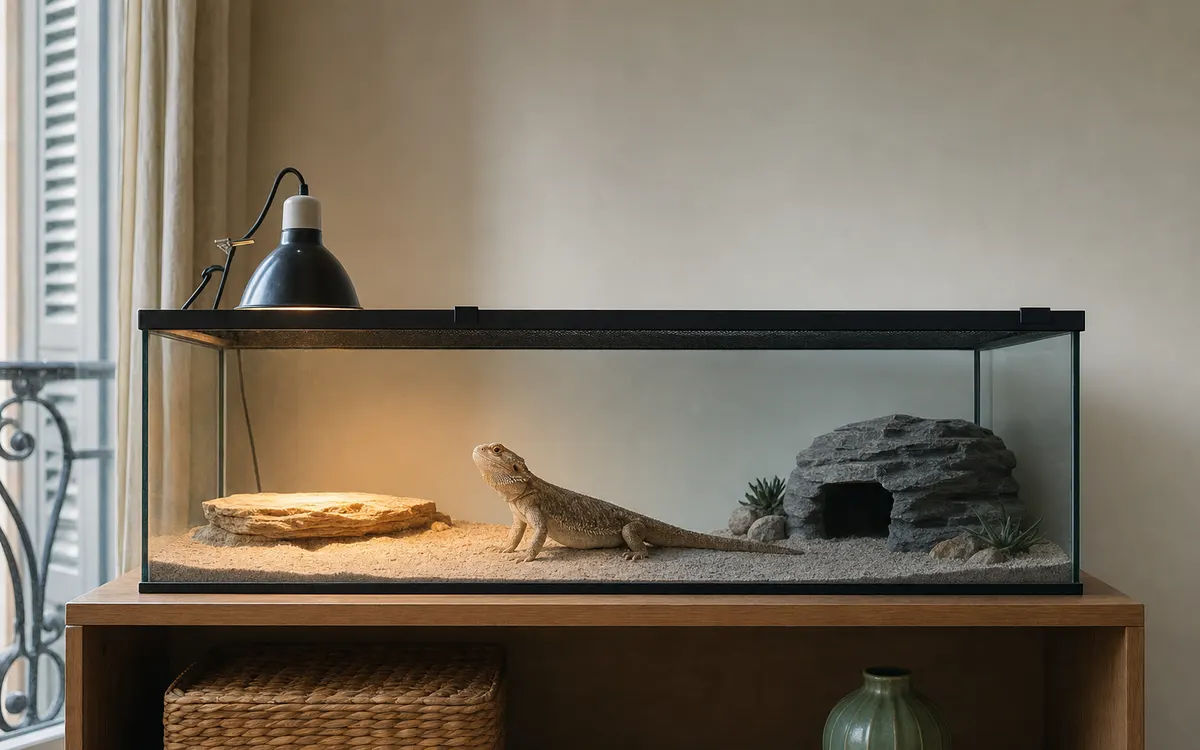
There is one idea that gets repeated and confuses many people starting with reptiles: that they are “cold-blooded” animals. It sounds as though they are cold, and that is not it. What happens is that they do not generate heat internally the way we do: they take it from the environment and regulate it by changing position.
That difference, which looks like a biology detail, is actually what decides whether a terrarium works.
A Terrarium Does Not Have One Temperature, It Has Two
A mammal maintains its temperature from within, which is why a room at 21 degrees suits it. A reptile cannot do that. Its way of raising body temperature is to sit in the sun; its way of lowering it is to move into the shade.
So what it needs is not a terrarium “at the right temperature” but a terrarium with a gradient: a warm end for basking and a cool end for retreating, with enough space to move between the two.
A terrarium at a uniform temperature, even the “ideal” one for the species, removes exactly the tool it uses to regulate its body. It is like giving it a thermostat with no dial.
Why the Gradient Affects Everything Else
A reptile’s body temperature does not just determine whether it is comfortable. It determines:
- Digestion. Many reptiles need heat after eating in order to digest. Without it, food can sit in the stomach and even ferment, which is a serious problem.
- The immune system. A chronically cold reptile fights infection less effectively.
- Activity. A listless animal that “does nothing” is often not calm: it is too cold to move.
- Appetite. Refusing food is one of the first effects of a badly built gradient.
That is why, when a reptile stops eating or turns inactive, the first thing an exotics vet checks is not the diet: it is the temperatures.
How to Tell Whether Your Gradient Works
The answer is not on the thermometer, it is in the animal.
A well-housed reptile alternates: it spends a while under the basking spot, then retreats to the cool end, then comes back. That back and forth is the sign that it can choose.
The signs that something is wrong are fairly clear:
- Always under the lamp, not moving: the terrarium is too cold overall.
- Always in the cool corner or hiding: the basking spot is too hot, or there is no shaded hide where it feels safe.
- Continuous open-mouthed gaping in species that do not normally do it: possible overheating.
- Lethargy, not eating, not defecating: sustained insufficient temperatures.
The Most Common Setup Mistakes
A single thermometer in the middle. It measures nothing useful: it gives you an intermediate point that does not exist for the animal. You need two, one at each end, and it is worth measuring the basking surface itself with a probe or infrared gun.
Heat sources with no thermostat. Any emitter, cable or mat can run away. A thermostat is not a luxury accessory: it is what separates a safe terrarium from a burn.
Heat rocks. A classic and a bad idea: the reptile does not always sense excess heat on its belly and can stay on top until it burns.
Terrariums that are too small. If the space is short, the two ends touch and the gradient disappears through physics, however well the lamps are positioned.
Lights on all night. Almost all species need a night-time drop and real darkness. If heat is needed overnight, use a source that emits no visible light.
What to Look Up Before Buying
Every species has its own ranges, and they genuinely differ: what is right for a leopard gecko is not right for a bearded dragon or a ball python. Before building the terrarium it is worth having four figures written down for that specific species:
- Basking spot temperature.
- Cool end temperature.
- Recommended night-time drop.
- UVB requirement, which is separate from heat and does not replace it.
With those four numbers, the setup stops being intuition and becomes something you can verify with a thermometer.
And as always in animal health, this is general guidance: faced with a reptile that has stopped eating, is lethargic or has marks on its skin, the decision belongs to a vet experienced in exotics, not a forum or the shop assistant.