
It is still the number one reason a pet reptile ends up at the clinic: metabolic bone disease. Bones that soften, legs that tremble, a jaw that no longer closes. And it is still, almost always, preventable.
The striking part is that most of those animals were receiving calcium. The problem with calcium for reptiles is hardly ever the missing tub: it is that calcium needs three things at once to reach bone, and only one of them has to fail.
The Three Pieces That Have to Line Up
1. Calcium in the food. Obvious, and the part everyone covers.
2. Vitamin D3, which almost always comes from light. Without D3 the gut does not absorb calcium, however much is dusted on. And in most diurnal reptiles D3 is not eaten, it is manufactured in the skin from UVB radiation. Without adequate UVB, the calcium passes straight through.
3. A favourable calcium to phosphorus ratio. This is the one that gets ignored. Phosphorus competes with calcium for absorption. If the diet carries far more phosphorus than calcium, the body ends up pulling calcium out of bone to balance the blood. The ratio to aim for across the whole diet is around 1.5 or 2 parts calcium to 1 of phosphorus.
And here is the underlying problem: almost every insect we buy has that ratio inverted. Crickets or mealworms sit at roughly 1 part calcium to 7 or 9 of phosphorus. Feeding a reptile on crickets alone, uncorrected, is slowly decalcifying it.
Two Different Operations on the Insects
They get confused often, and they are not the same thing.
Gut Loading: Feeding the Insect
This means feeding the insect properly for the 24 to 48 hours before offering it. The insect becomes the container for whatever it has eaten.
What works: calcium-rich greens such as collard, turnip tops or dandelion, squash, a small amount of carrot, and purpose-made commercial gut-loading feeds. What to avoid as a base is bran and bread, which is what they are raised on in the shop and exactly what leaves that terrible ratio.
There is no need to run a farm: a ventilated box, some fresh greens refreshed regularly and doing it the day before feeding is enough.
Dusting: Coating the Insect
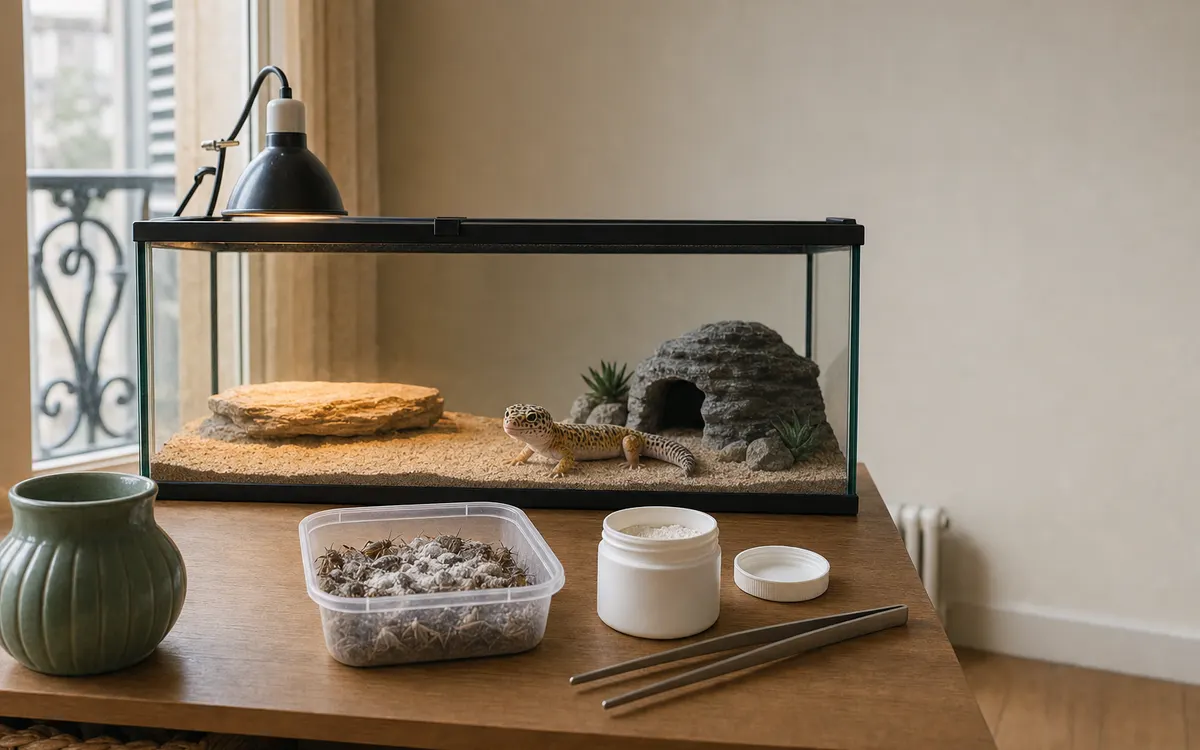
Put the insects in a bag or tub with a pinch of powdered calcium carbonate and shake gently until they carry a thin coat, not white like doughnuts. The excess falls off in the enclosure and contributes nothing.
Two details that prevent common mistakes:
- Calcium with or without D3. With correct UVB, day-to-day dusting should be without D3, and the D3 version occasional. Without UVB, the reverse, and always on veterinary advice.
- The multivitamin is separate and infrequent. Once or twice a month. It provides vitamin A, which is needed, but whose excess is toxic.
UVB, Where Most Money Gets Wasted
It is the part of the enclosure that is bought worst, and it deserves saying plainly:
Compact screw-in “full spectrum” bulbs give very little usable UVB. Desert species like a bearded dragon or a uromastyx need a high-output linear T5 tube, mounted along the basking area at the height the manufacturer specifies.
Glass and most plastics block UVB. If the tube sits outside a glass lid, nothing is getting through. If there is mesh, it filters a significant share, and you compensate with height.
Tubes expire before they blow. They keep producing visible light long after they have stopped emitting useful UVB. Replace every 6 to 12 months depending on the model, with the date written on the tube in marker pen. It is the most common failure and the most silent.
There must be a gradient and shade. The animal needs to be able to leave the UVB zone. An enclosure lit evenly everywhere gives it nothing to regulate.
Nocturnal or crepuscular species such as leopard geckos and crested geckos are a separate case: they have traditionally been kept without UVB and with oral D3, although current practice leans towards offering low-intensity UVB, which appears beneficial provided there are genuinely shaded hides.
Herbivores: Same Problem, Different List
With tortoises and iguanas the shopping list changes, but the logic is identical.
Here the trap is oxalates. Vegetables like spinach, chard and beetroot leaf contain calcium, but also oxalates that bind it and make it unusable. And iceberg lettuce is essentially water.
The base should be greens with a good calcium profile: collard, turnip tops, chicory, escarole, dandelion, mulberry leaf. Grass and hay for tortoises, in quantity. Fruit should be token: it is sugar and it unbalances gut flora.
Calcium supplementation is still needed, dusted over the greens two or three times a week in adults and more in juveniles.
When the Dose Has to Go Up
Three moments send requirements sharply higher, and the normal routine falls short:
- Growth. A juvenile is building skeleton at full speed.
- Females in the laying phase. Every egg carries a shell, and that shell comes out of the mother’s bone if the diet does not supply it. It is the classic cause of spontaneous fracture in female bearded dragons, even with no male present.
- Recovery after illness. Under veterinary direction, not improvised.
Early Signs Worth Checking Weekly
Before a fracture, there are warnings:
- Fine tremor in the legs when walking or standing up.
- The animal drags its belly instead of lifting the body.
- Bent toes, new curves in the tail.
- A jaw that looks soft or does not fully close.
- In bearded dragons, visibly widened jaws.
- Less activity, less appetite, abnormally long basking sessions.
If any of these appear, the visit is to an exotics vet, with X-rays. Metabolic bone disease can be halted and partly recovered, but deformities already in place do not undo themselves.
A Summary That Fits on the Enclosure Door
Insects gut loaded for 24 to 48 hours beforehand. A light dusting of calcium without D3 on most feeds. Multivitamin once or twice a month. A correct T5 UVB tube for the species, with no glass in the way, replaced every 6 to 12 months with the date noted. A basking spot and shade so the animal can choose. And for herbivores, calcium-friendly greens instead of spinach and lettuce.
With that, calcium stops being a white powder shaken on out of habit and becomes something that actually reaches the bone.