
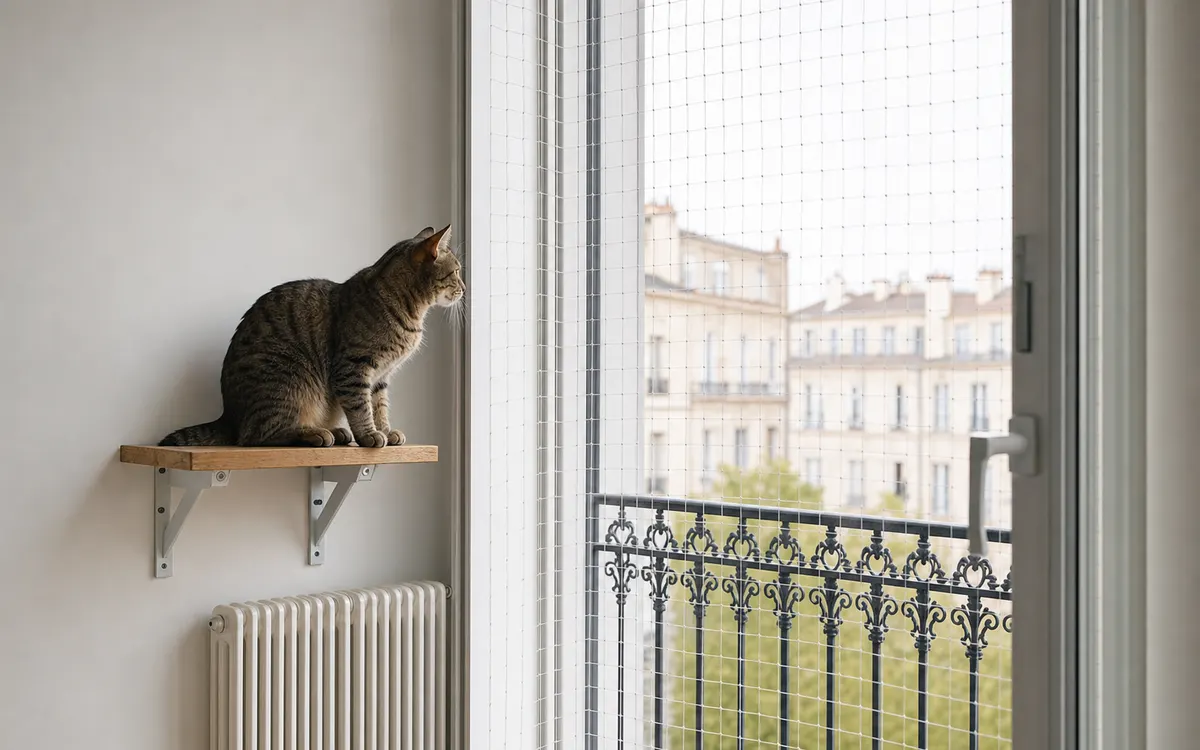
You have seen it a hundred times: your cat climbs onto the railing, stretches its neck and looks into thin air as if measuring the jump. Your stomach tightens. And however often you lift it down, five minutes later it is back up there. It is not ignoring you, and it is not reckless either. Its brain is simply built for this.
Understanding why your cat climbs onto the balcony railing is the first step to getting rid of the fright. Because once you know what pulls it to the edge, you can give it exactly that without putting it in danger. Here you will find what is going on in its head and, above all, what you can do today so the balcony becomes its favourite sunny spot again rather than a permanent building site in your mind.
What pulls it to the edge
There is not one reason but several, and they usually act at the same time.
The instinct for height
In nature, height means control. From above a cat sees danger coming, surveys its territory and feels safe. Your balcony is the highest point in the home with the best view, so to your cat it is the perfect observation post. Climbing up is not rebellion, it is biology.
Curiosity and movement
Birds, leaves, cars, a bag in the wind, the neighbour hanging out washing. The street is a television programme that never ends. Cats are hunters by nature, and movement triggers an impulse they cannot ignore. The more boring it is indoors, the louder the show outside calls.
Smell and air
The balcony gathers smells that never reach indoors: other people’s kitchens, plants, other animals, damp, soil. To a cat that cocktail of information is irresistible. It climbs up to read the world with its nose.
The search for the right temperature
Sometimes the explanation is more mundane: it is warm indoors, there is a draught outside, or the sun hits exactly that corner of the parapet. Your cat is looking for its perfect spot, and that spot sits dangerously close to the edge.
The risk many underestimate
Now the uncomfortable part. Veterinary medicine recognises a condition called high-rise syndrome: the injuries cats sustain falling from balconies and windows. Fractures, trauma and internal injuries are common consequences. We describe it in full in the article on high-rise syndrome in cats.
And beware of the most dangerous myth: that cats land on their feet does not mean nothing happens to them. A cat loses its balance chasing a fly, slips on a wet parapet or misjudges a jump. Its agility is enormous, infallible it is not. One moment is enough to turn an hour of sunshine into an emergency.
How to make the balcony a safe zone
You do not have to choose between your cat’s safety and its quality of life. The answer is not to shut the balcony off forever, it is to make it accident-proof. In this order:
- Close the opening physically. This is the most effective measure. A properly fitted cat safety net covers the whole balcony edge and rules out the fall, without taking away your view or your air. Everything else builds on this.
- Check the weak points. There is no use covering the railing if a gap is left between the bars, underneath or at the side. A cat fits through any opening its head fits through.
- Give it a safe lookout. Once the balcony is secured, put a bed, a shelf or a hammock on the closed side. That way you steer its instinct for height to a controlled spot.
- Reduce boredom indoors. A cat whose needs are met climbs less out of frustration. Vertical scratching posts, moving toys and daily play sessions noticeably lower the fixation on the edge.
Mistakes to avoid
- Trusting that your own cat is calm. Temperament prevents neither slips nor frights.
- Leaving the balcony door open just briefly. Accidents happen in seconds and almost always when nobody is watching. The barrier has to be permanent, not situational.
- Telling it off when it climbs up. Punishment does not remove an instinct, it creates stress. Change the environment instead.
- Fitting wobbly solutions. A badly tensioned or weakly anchored net can give way and lulls you into false confidence.
The basic idea is simple: do not fight your cat’s instinct, work with it. Let it lean out, sunbathe and guard its territory, but in a space where a fall is impossible. If it matters to you that nothing shows from the street, the transparent cat safety net is the most discreet option.