
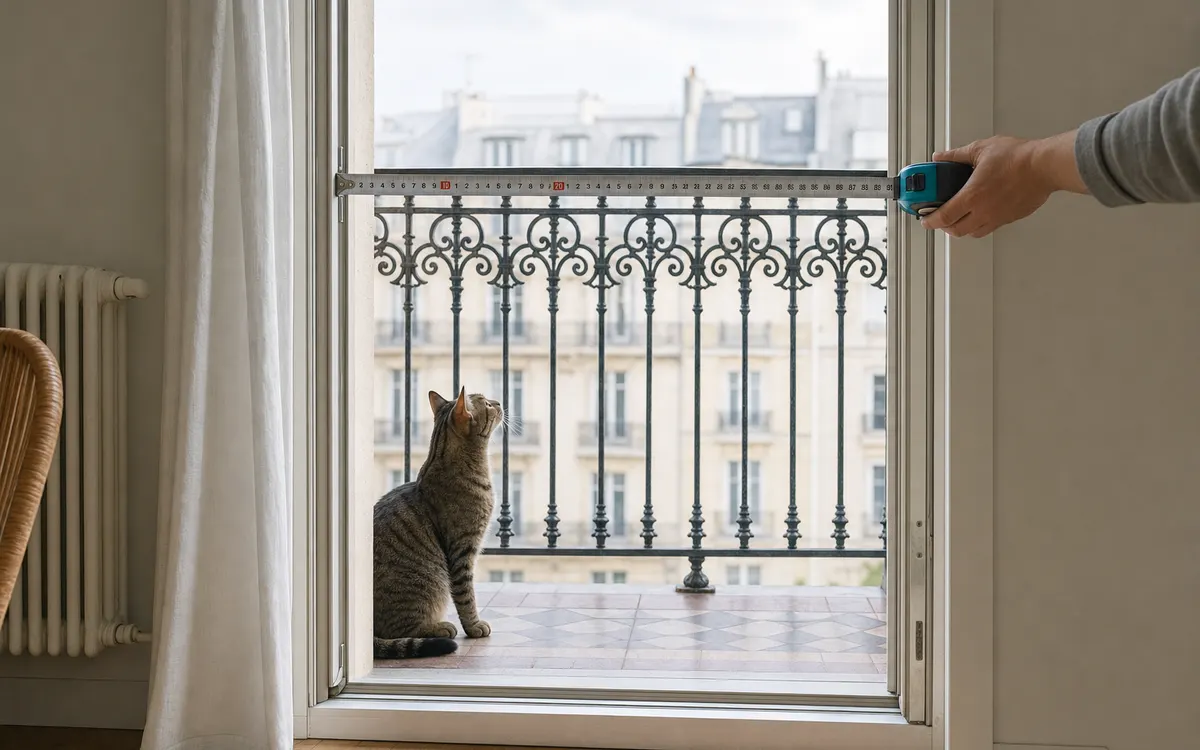
You have a cat, a balcony and a question that will not leave you alone: what cat net size do I need so that it neither escapes nor falls? That is the right question, because a badly measured net does not protect. It leaves gaps, sags, or ends exactly where your cat will try it. And cats find the weak point reliably.
The good news is that measuring properly is simpler than it sounds. You need no DIY talent and no special tool, just a tape measure, five minutes and the information on what to look for. After that you will know whether 4 x 3 m is enough or whether you should go for 8 x 3 m.
Why the measurement decides everything
A safety net only works if it closes the entire opening your cat could fit through. Not approximately. An adult cat squeezes through surprisingly small gaps, and a net that stops ten centimetres short of the frame is barely a net at all.
The goal when measuring is therefore not that it fits, but that there is some left over. A slightly oversized net you tension again or fold over. One that is too small forces you into improvisations, and improvisations do not hold.
How to work out your size
Take a tape measure and measure the opening you want to close:
- The width. From one end to the other, so for example between the two walls or the side ends of the railing.
- The height. From the floor or the base of the railing up to the point you want to cover at the top.
- Note both figures. Width by height, in metres. That is your actual opening.
- Add the margin. Roughly 10 to 15 cm per side, so you can fix and tension the net without working to the edge.
Why the margin is not optional
A net cut exactly to size loses tension through use, wind and your cat’s jumps. That reserve is precisely what lets you tension it again when it loosens, and fix the edges generously at the anchor points. It is like a belt: better one hole too many than one too few.
4 x 3 m or 8 x 3 m: the honest way to decide
Both versions are three metres high, they differ in length. Decide like this:
- 4 x 3 m suits the classic city balcony with a straight front, a single window and smaller loggias. In those cases there is even material left over for tensioning.
- 8 x 3 m is the choice for long terraces, for balconies that turn a corner, and anywhere you need to close several sections. The advantage is less about price than about safety: a continuous surface has no joins, and joins are the classic weak point.
If you are torn between the two, take the bigger one. Excess you can fold, shorten or pull into the corner. Missing area you cannot invent. Both sizes come in transparent and black, with and without drilling, in the cat safety net overview.
Balconies with an awkward shape
Not every balcony is a clean rectangle. If yours has corners, pillars or an irregular railing, the trick is to split the area into sections and measure each one separately.
- Corner balcony: measure each straight section as its own opening and add them up.
- Railings with wide bars: measure from the outer bar, not from the inside, so no gap is left between the grille and the net.
- Windows and high terraces: measure the height too, up to the point your cat can climb. Cats jump further than you give them credit for.
The most common measuring mistakes
Most problems with a net do not come from the net, they come from a poor measurement. These are the classics:
- Measuring only the visible opening and forgetting the gap under the railing, which a slim cat passes through comfortably.
- Allowing no margin and ending up with no material to tension with.
- Working by eye instead of with a tape measure. Ten centimetres of error is exactly the gap that counts.
- Forgetting the height. Closing the width and leaving the top open is an invitation to climb.
Once you have noted the width and height including margin, you can choose with confidence. After that, fitting is no longer a gamble but a quiet hour of work: how to tension the surface evenly is set out step by step in the fitting guide.