
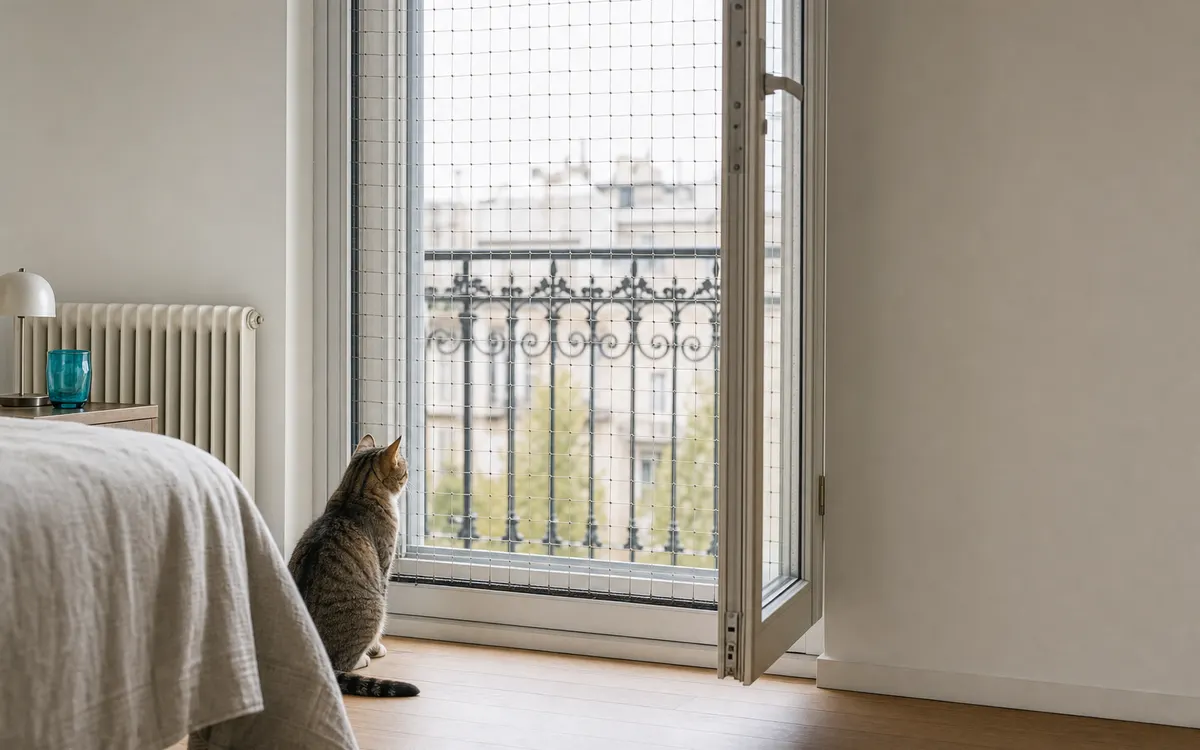
The idea that cats always land on their feet and never get hurt is a stubborn one. It is a dangerous mistake, and understanding why cats fall from balconies is the first step to preventing an accident that can end very badly. Veterinary medicine even has a name for the pattern of injuries: high rise syndrome in cats.
Here you will find what lies behind it, why such an agile animal falls at all, and above all how to prevent it at home. Because your cat is part of the family and should be able to enjoy the balcony without carrying an unnecessary risk.
What high-rise syndrome is
The term covers the set of injuries a cat sustains falling from height, typically from a balcony, a window or a terrace.
Cats have a remarkable reflex that lets them rotate their body during a fall and try to land on their feet. That reflex does not prevent the injuries, though. The most common are fractures to the limbs, injuries to the jaw and palate, damage to the ribcage and internal injuries. It is not rare: in cities, with the first warm weather and open balconies, practices see a clear rise in these cases every year.
Why cats fall in the first place
Knowing the causes takes away the false sense of security. The most frequent are:
- Hunting instinct: a bird, a fly or a moving leaf switches the cat on, and it jumps without factoring in the drop.
- Balance and sleep: it dozes off on a narrow parapet or loses its grip on a slippery surface.
- Curiosity and play: it explores ledges and edges without any real sense of danger.
- Fright: a loud noise or a sudden movement triggers an uncontrolled jump.
The big misunderstanding is believing that agility protects them. Agile they are, but a mistake several metres up forgives nothing, however good the reflexes.
The myth of landing on their feet
The conviction that a cat always lands on its feet and walks away unhurt has done a great deal of damage. It is true that they have a righting reflex with which they orient the body during a fall. That does not make the fall harmless.
Landing on their feet from a height sends enormous forces through the limbs, the jaw and the spine. In falls from very high floors, further factors make the outcome worse still. The conclusion is simple: no cat is safe purely because it is a cat. Trusting that myth is exactly why many owners never secure the balcony.
How to prevent the fall
Prevention is the only genuinely effective tool, and it is in your hands:
- Fit a safety net: the physical barrier that closes off the edge, by far the most effective measure.
- Check windows and openings: tilt-and-turn windows and narrow gaps are a risk too, not only the balcony. That is what the cat safety net for windows is for.
- Move furniture away from the edge: so that chairs or planters do not act as a springboard onto the parapet.
- Enrich the home: a cat that is occupied indoors looks for excitement outdoors far less.
The PetsLovers cat safety net is made for exactly this: available in transparent or black, in 4 x 3 m and 8 x 3 m, with a fixed fitting or without drilling, so you can install it whether you own your home or rent it.
Prevention and supervision belong together
A properly fitted net completely changes how calmly your cat uses the balcony. It cuts the risk of a fall considerably and lets it lean out, watch the street and sunbathe without you having to stand there every second.
Even so, the honest note: no net guarantees one hundred per cent safety. A loose fitting, an unclosed gap or a particularly determined cat can cause problems, so a regular check is worth it and your attention stays part of the solution. Prevention and supervision together protect the one who is, in the end, family.