
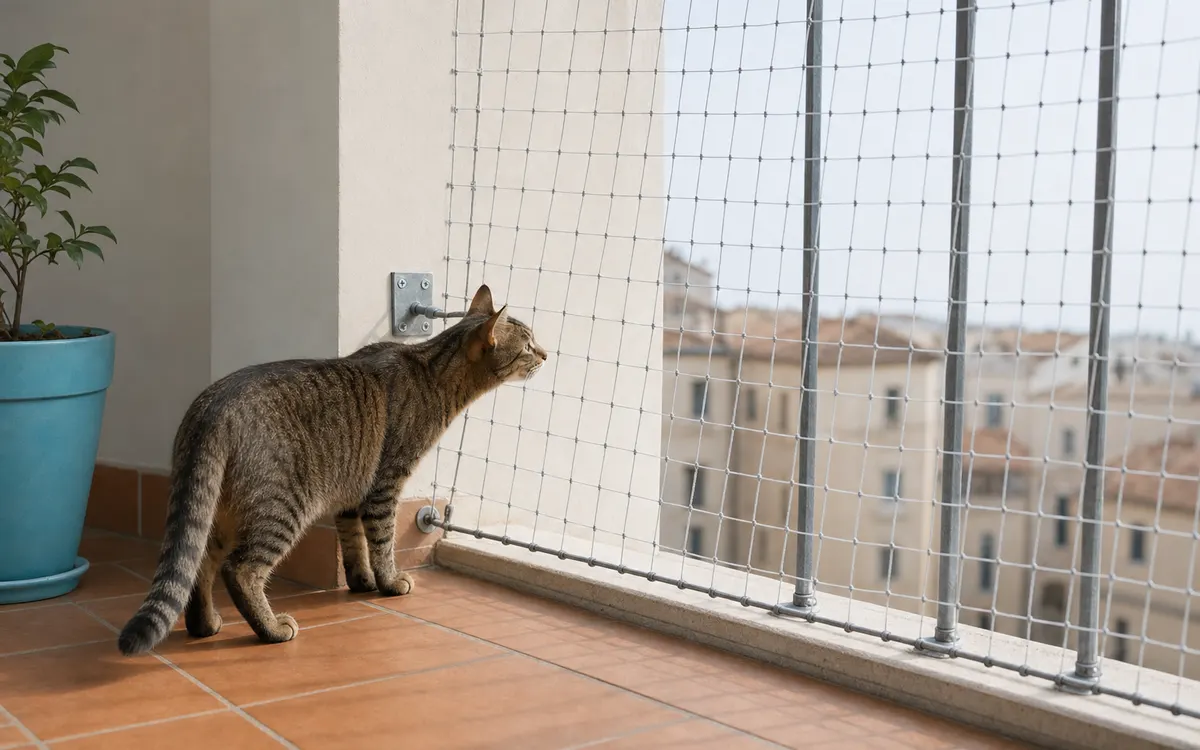
If you live in a flat with a balcony and you have a cat, you have certainly asked yourself this: can a cat fall from a balcony? The short answer is yes. And not because your cat is clumsy, but because even the most sure-footed cat miscalculates when it chases a fly, gets startled by a loud bang or falls asleep on a narrow parapet.
The idea that cats always land on their feet and never put themselves in danger is a stubborn one. That mistake costs many cats their health every year. Here you will find why falls happen, what lies behind so-called high-rise syndrome and above all what you can do today so that your balcony stops being a risk.
Why cats fall in the first place
No cat jumps into thin air on purpose. What goes wrong is the combination of hunting instinct and a moment of inattention. A bird, an insect or a leaf in the wind is enough for your cat to switch into hunting mode and tune out the edge completely.
These are the situations that most often end in a fall:
- Chasing prey: a bird or an insect within reach triggers an impulsive jump with no distance control.
- Narrow parapets and edges: cats walk in impossible places, but one slip or a gust of wind is enough.
- Sudden fright: a firework, a slamming door or building work next door makes them jump uncontrollably.
- Napping up high: many cats sleep on sunny parapets and fall while stretching or turning over.
The real problem is not the height itself, but that the cat does not perceive the balcony as a danger. That is exactly why it falls to us.
What high-rise syndrome is
In veterinary medicine the term high-rise syndrome covers the typical pattern of injuries after a fall from a significant height, usually from windows or balconies on upper floors.
Cats can rotate their body during a fall remarkably well and bring their paws downwards. But that does not make them immune. A fall can cause fractures, jaw injuries, damage to the ribcage or serious internal injuries. Landing on their feet does not mean landing unhurt. There is more on this, and on how veterinary medicine frames it, in the article on high-rise syndrome in cats.
The practical conclusion is simple: the best injury is the one that never happens. Prevention is cheaper, faster and gentler than treatment.
Low floors count too
Many people think only the seventh floor is dangerous. A fall from the first or second can cause serious injuries just the same, and on top of that the cat can run off, hide or end up in the street. Prevention does not depend on the floor: if the balcony is open, the risk is there.
How to secure the balcony without losing light
You do not have to choose between your cat’s safety and your terrace. There are simple solutions without building work that let light and air through:
- Fit a safety net: the physical barrier that closes the balcony or window opening and stops your cat getting out or falling. It is discreet and does not take away your view.
- Check insect screens and parapets: a standard screen will not hold against a cat at a run and is not a safety measure.
- Supervise the first outings: when your cat uses the secured balcony for the first time, watch how it behaves for the first few days.
- Remove dangerous stepping stones: planters and furniture it could use to get above the protection.
If you want to really close the opening, a cat safety net for balconies and windows is the most effective option. It holds up against your cat’s attempts to lean out and lets you keep using the terrace. If you rent, or the facade has to stay untouched, there is the version without drilling, which comes down without leaving a trace.
Signs that your cat is particularly at risk
Every balcony should be secured, but some cats need extra attention. Be more watchful if your cat:
- is young, playful and very active, because young cats act especially impulsively,
- spends half the day watching birds from the window,
- has already tried to lean out or climb onto the parapet,
- reacts very fearfully to loud noises.
If you recognise your cat in any of these, do not put it off. Closing the edge is one of those decisions you make once and that spares you a fright nobody wants to live through.