
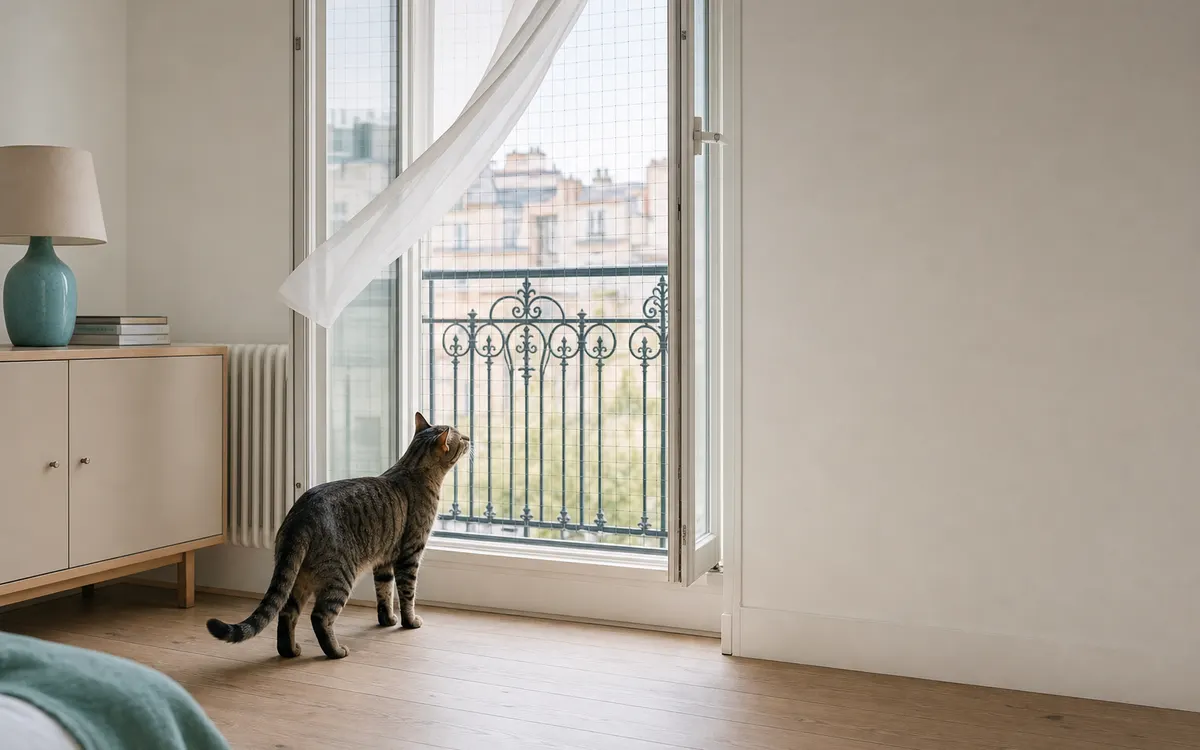
You open the window to air the room for five minutes, the doorbell rings, and when you come back your cat is already on the windowsill looking at the street. Your heart stops. If you have a cat and live in a flat you know the scene, and it is not an exaggeration: to a cat an open window is not a danger, it is an invitation. Instinct tells it there are birds out there, new smells and territory to explore.
The good news is that stopping your cat escaping through the window does not depend on supervising it around the clock, because that is impossible. It depends on removing the opportunity. Here you will find why it does it, which risks are real and which solutions work day to day.
Why the window pulls at it so hard
Before you cover the problem it helps to understand where it comes from. A cat does not sit at the window to break out in the human sense, but because it follows very concrete instincts that have no other outlet in a flat.
- Hunting and stimulation: the movement of birds, insects or cars switches on its prey drive.
- Territory: it wants to patrol and mark what it considers its own, and the outside world is part of that mental map.
- Boredom: a cat with little to do looks for stimulation wherever it can find it, and the window is the most entertaining cinema in the house.
- Temperature and smells: fresh air and new smells are irresistible to its nose.
The point is this: the more boring it is indoors, the harder the window pulls. That is why the complete solution combines a physical barrier with a home where something actually happens.
The risk is not only the fall
Many people think the danger is only that the cat jumps into thin air. That is the most serious one, but not the only one.
- Falls from height: cats are agile, but a moment of distraction, a bird within reach or a slip is enough for a serious accident.
- Escape to the outside: if it reaches a roof, a courtyard or the stairwell, a frightened cat hides and disappears for days.
- Getting trapped: in tilted windows it can get stuck trying to slip through the gap at the top, and that is life-threatening.
The honest framing is this: no measure removes the risk one hundred per cent, but a properly fitted barrier lowers the probability drastically. The point is to close doors rather than rely on luck.
The solutions that work
Ordered from the most effective to the supporting ones.
A safety net
By far the most complete solution for windows, balconies and terraces. A net lets you open wide and air the room while your cat stays indoors, without giving up the view or the fresh air. It adapts to different openings and, pulled tight, closes exactly what every other measure leaves open: the large opening. For windows, the cat safety net for windows is the right version. If the balcony door is in daily use, the sliding version is more practical, because you pull it aside instead of detaching it.
Reinforced insect screens
A standard insect screen is not enough: the mesh is thin, and a cat tears it with its claws in seconds or unhooks it. There are reinforced screens with a sturdy frame, but they usually cover only one window type and push the cost up. As a supplement they are fine, as a replacement for a barrier built for a cat’s strength they are not.
Supervision and routine
No physical measure replaces common sense. Keep the riskiest windows shut when you are out, be especially careful with tilted windows, and check now and then that the barriers are still firm. Supervision on its own is not a solution, but it reinforces everything else.
How to fit it without mistakes
A net only protects if it sits correctly. These points make the difference between a reliable barrier and a false sense of calm:
- Measure the opening properly: the width and height of the window or balcony before you buy, with extra for tensioning.
- Tension with no slack: a loose net forms pockets your cat can push into. It has to sit firm, including at the edges.
- Close the corners: cats always look for the weak point, and it is usually a badly fixed corner.
- Check the fixings: make sure the anchors really grip on your frame and your wall.
- Look again regularly: over time and with sun the tension drops.
Make the home more interesting than the street
As a reminder: the less boring it is indoors, the less the outside pulls. The physical barrier solves the safety, the home solves the motivation. Together they give you a relaxed cat and a safe house.
- Scratching posts and height: places to climb and observe indoors.
- Daily play: a few minutes of simulated hunting with a wand discharges the drive.
- Activity: food mazes and toys you rotate so they do not go stale.
- A safe lookout: a shelf at a secured window gives your cat its cinema without the risk.