
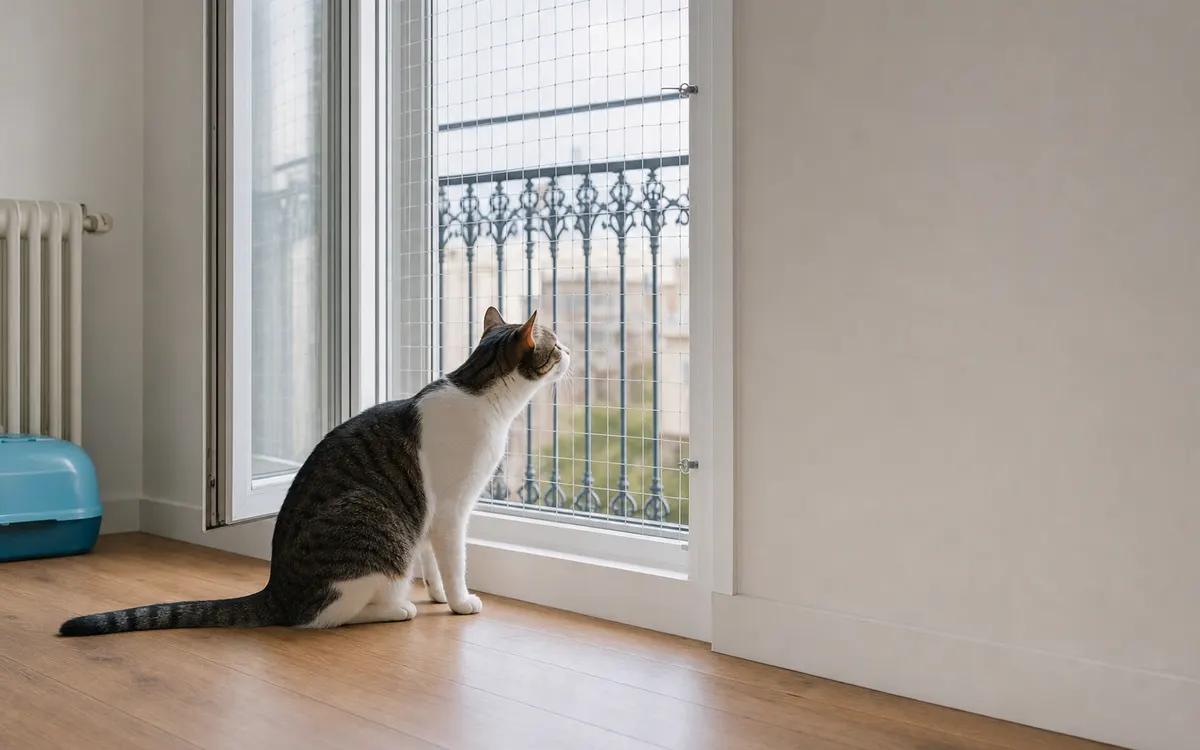
The weather turns warm and the first thing you do is open the windows so the air moves through the flat. Completely logical. The problem is that your cat thinks exactly the same way: the open window is the best seat in the house, with a breeze, birds and a cinema view. And that is precisely where the frights begin.
In summer the airing hours go up, insect screens hold less than you think, and your cat spends more time on the windowsill. It does not have to be clumsy or reckless: a bird going past, a loud noise or a miscalculated jump is enough. Here you will find where the real risk lies with a cat, an open window and summer, and what you can do about it today.
Why summer multiplies the risk
The danger is not new, summer just concentrates it. Three things change at once:
- More open windows, more hours. You air the place in the morning, in the evening and in between. Every hour of open window is an hour of exposure.
- More stimulation outside. Birds, insects, neighbours on the terrace, other cats. Anything that moves switches on the hunting drive and pulls your cat towards the edge.
- False confidence. An insect screen is meant to keep mosquitoes out, not to take the weight and push of a cat. It is easy to rely on it, and that is exactly what you should not do.
A detail many people miss: cats do not only fall from great heights. A second floor, a light well or a low balcony can cause serious injuries too. Height makes the outcome worse, but it is not a prerequisite.
The myth of landing on their feet
You have heard it a thousand times: the cat always lands on its feet, nothing happens to it. That half-truth does a lot of damage. Yes, cats have a very good righting reflex and they are agile. That does not make them immune to falls.
A fall can cause fractures, internal injuries and serious damage, even when the cat appears to land cleanly. And if it falls while distracted, asleep in the sun or startled by a noise, it does not even have time to orient itself. Trusting that the cat will save itself hands its safety over to chance. What veterinary medicine calls this pattern of injuries, and what it covers, is in the article on high-rise syndrome in cats.
How to secure windows and balcony
The good news is that this is fixable, and neither expensive nor complicated. The idea is simple: if the cat cannot reach the edge, there is no fall. From the simplest measure to the most effective.
What you can do right now
- Careful with the tilt position. A tilted window looks safe, but it leaves a wedge-shaped gap at the top where a cat can get trapped trying to slip through. It is one of the most dangerous traps and should never be accessible unsecured.
- Air the room with the door closed. If you open everything wide for a through draught, keep your cat in another room while you do it.
- Do not leave springboards. Shelves or sofas right by the window give it the perfect run-up to the sill.
The permanent solution
Temporary fixes are fine in the moment, but you only get this off your mind with a permanent physical barrier between your cat and the outside. A properly fitted net lets you air the place as much as you like without standing there, and that is exactly what you want in summer.
For windows, the cat safety net for windows is the right version, and the same logic applies to balconies and terraces. If you do not want holes in the frame or the facade, there is fitting without drilling. Three points matter when choosing and fitting:
- Cover the entire opening. A cat looks for every gap. The net has to close the whole frame, including at the sides.
- Anchor it firmly. A loose or badly fixed net is no use. The fixing matters as much as the net.
- Check it regularly. Sun, wind and use take their toll on the material. An occasional look saves surprises.
A summer routine for both of you
With the barrier in place, the rest is common sense, so summer is pleasant for you both:
- Always fresh water and several bowls around the flat, because heat dehydrates.
- Shaded spots where your cat can lie away from the full sun on the windowsill.
- Activity indoors: toys, scratching posts and a good secured lookout lower the urge to lean out.
- Watch its behaviour. If you see panting, lethargy or anything else unusual in the heat, ask your vet.
Your cat’s safety is not a matter of luck, nor of permanent supervision. It is a matter of the barrier between it and the danger. You air the flat, enjoy the summer, and your cat watches the world go by in peace.