
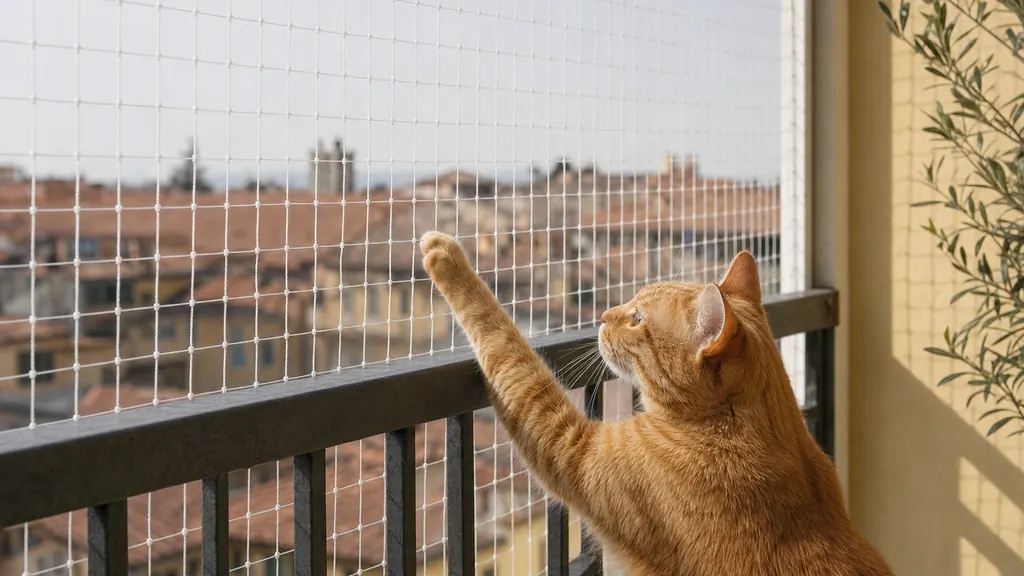
There is one scene that repeats itself in almost any home with a cat: it is seven in the evening, you are doing something in the kitchen, and your cat is at the same window as always, sitting in exactly the same position, watching the street. It has been there forty minutes. It isn’t meowing, it isn’t moving, it doesn’t seem to be waiting for anything. And at some point the same question crosses all our minds: is it entertained or is it bored?
A cat staring out the window for hours worries almost every owner at some point. The short answer is that it is almost always entertained, and considerably more than it looks from the outside. For an indoor cat, the window is the closest thing it has to a television channel made to measure.
What a Cat Staring Out the Window Is Actually Seeing
Looking out of the window, we see cars and people. A cat sees something completely different, because its attention is calibrated to detect movement before shape or colour.
- Small, fast movement: a bird hopping between branches, a leaf dragged along, an insect against the glass. All of it fires the same circuit real prey would.
- Routines and patterns: cats notice that the same dog goes past at a certain time, or that mid-morning the sun hits one particular ledge. That predictability is comfortable for them.
- Other cats: a cat on a roof or at the window opposite is important territorial information, not a detail.
- Smells and sounds, if the window is ajar. This is where the stimulus multiplies: smell carries far more information than sight.
Put another way: it isn’t a blank screen. It is a constant stream of relevant data, and watching without spending energy is a perfectly feline strategy.
When the Stare Is Pleasure and When It Is Frustration
This is the useful part, because the same behaviour can mean two opposite things. What changes isn’t the place, it is the body.
Signs it is enjoying itself
The body is loose, sometimes half lying down. The tail is still or moves slowly. The ears orient towards sounds but without tension. And above all, it gets tired and goes off to sleep somewhere else of its own accord. That is the normal pattern.
Signs of frustration
Here the tone changes: insistent meowing at the glass, scratches on the frame, a tail thumping the floor in sharp strokes, repeated attempts to push a paw through a gap, or the characteristic teeth chattering at the sight of a bird. A cat like that isn’t entertained: it is looking at something it wants and can’t reach.
Occasional frustration isn’t a problem; it is part of living indoors. But if it is the usual state, it is worth compensating for indoors. The route isn’t to take the window away, it is to give that hunting energy an outlet: short play sessions with a wand toy imitating prey movement, hiding food so it has to search, rotating toys so they don’t become invisible through habit.
Why It Always Picks the Same Spot
If you have three windows and your cat uses one, it isn’t chance. Usually three things combine: there is sun at a certain hour, there is a surface where it can lie down instead of standing, and from there it sees more than from anywhere else. Height counts for a lot. Cats watch better from above because they control more of the visual field and feel less exposed.
It is one of the cheapest improvements you can make at home: putting something stable and comfortable by that particular window (a shelf, a cleared piece of furniture, a cat tree with a platform), so that watching time is also resting time. Many cats go from tense vigilance to falling asleep right there.
Where This Meets Safety
It is worth being clear here, because this is the part most often overlooked. A cat that spends its afternoons focused on the window is a cat that is highly motivated by what is on the other side. And that motivation doesn’t distinguish between a closed window and one left ajar for ventilation.
You don’t need a balcony for there to be a risk: an open window on the third floor is practically the same scenario as an unprotected terrace. Cats don’t judge heights the way we assume, and a bird passing close can turn a measured jump into a badly calculated one. If it is a tilt-and-turn window left open in ventilation mode, the gap is more than enough.
The answer isn’t keeping the house shut all summer. How to secure a window without taking away your cat’s view explains in detail how that gap is closed while keeping the light and the view, and why on windows most people choose the transparent net, almost invisible from inside. With the gap covered you can air the room without that knot in your stomach every time you open up.
That said, honestly: a net greatly reduces the risk, it doesn’t remove it, and it doesn’t replace you keeping an eye out, especially in the first few days or with young cats.
What You Can Do This Week
If your cat spends hours at the window and you want that time to count for something:
- Watch for two or three days how it looks: relaxed or tense body. That tells you whether you need to compensate with play.
- Make its favourite post comfortable, with something stable at the height it already watches from.
- Add two short hunting-play sessions a day, ideally before meals.
- Check the gap: if that window opens for ventilation, cover it before the first hot day, not after the first scare.
Your cat staring out of the window isn’t a sign that something is missing. It is one of the things it does best. The only part that is in your hands is making that spot comfortable, stimulating and, above all, safe.