
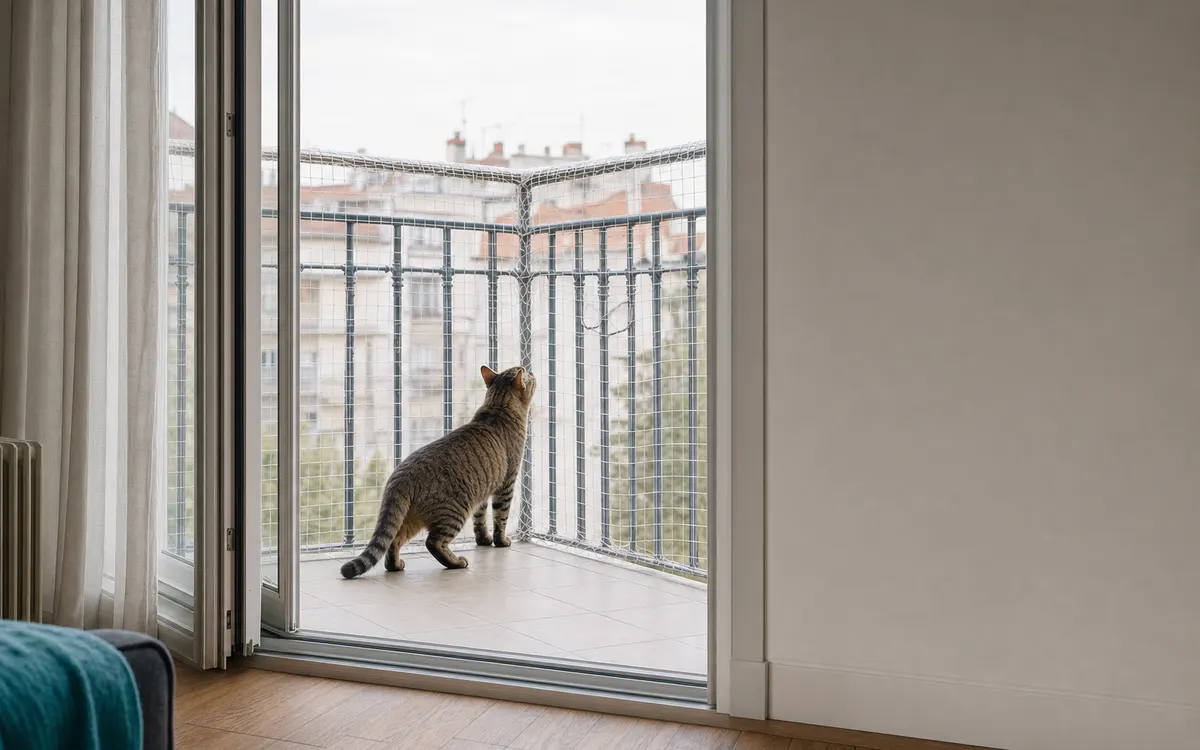
Your cat looks at the balcony the way you would look at the best television in the world: birds, wind, a patch of sun that is perfect for sleeping. The problem is that instinct understands nothing about height. A cat can misjudge a jump, slip while chasing a fly, or simply doze off and fall from the handrail. It is not clumsiness. It is that a normal balcony is built for people and not for an animal that climbs, jumps and squeezes through impossible gaps.
The good news is that opening the window and having a relaxed cat on the balcony are not mutually exclusive. You just need to check a few things before you let it out. Here is the cat proof balcony checklist, without the scaremongering.
Why a normal balcony is not safe
The risk is not only in the height. It is in the details you notice once it is too late. A cat fits through a much smaller opening than you imagine, and curiosity takes it exactly there.
- The gaps between the bars: if the head goes through, the body follows. Many railings are designed so that a child cannot get through, not a cat.
- The open top: a cat jumps onto the handrail effortlessly, and from there one wrong step changes everything.
- Furniture against the railing: a chair, a large planter or a shelf becomes a springboard.
- Distraction in hunting mode: cats lock onto a bird or an insect and lose their balance doing it. This is not a legend, it is one of the most common causes of falls.
The conclusion is uncomfortable but clear: supervision is not enough. Two minutes of distraction and the balcony is dangerous again. The solution has to be physical rather than depend on your attention.
The checklist before you open the door
Work through these in order. If you can tick them all off, your cat is far better protected.
- Measure the gaps. Check the spacing in the railing and every opening between the balcony floor and the base of the railing.
- Check the top. Can your cat reach the handrail? If so, that area has to be closed off too.
- Remove the springboards. Chairs, tables, tall planters and anything that gives extra lift towards the edge.
- Secure the insect screens. A standard screen will not hold against a cat at a run. It needs a solid fixing or a reinforcement.
- Check the plants. Some much loved balcony plants are toxic if a cat nibbles them. Put them out of reach or swap them out.
- Fit a safety net. It closes all of the previous gaps in one go.
- Provide shade and water. If the cat stays out for a while, it needs a cool spot and fresh water.
The net is the piece that closes everything
You can move the furniture and vet the plants, but as long as the edge stays open the risk stays too. That is where the net comes in. Fitted properly, it turns an open balcony into an enclosed space where your cat can lean out, sunbathe and watch the street with no escape route and no drop.
What to look for when choosing and fitting one
- Cover the entire edge, including the top if your cat jumps onto the railing.
- A mesh tight enough that it cannot push its head through.
- A solid fixing at every point, with no loose areas where it can lean and slip past.
- Tight, with no slack, so it does not form a hammock the cat can put its weight into.
A version made for exactly this is the cat safety net for balconies and terraces. If you are renting and do not want holes in the facade, fitting it without drilling is the right variant, and it comes off without a trace when you move out.
The most common mistakes
Many falls happen not because a net is missing, but because of details in the fitting or too much confidence.
- Leaving one small gap open. For a cat there is no such thing as a small gap.
- Assuming an old or calm cat will not jump. A bird changes that in a second.
- Never checking the net. Sun, rain and use wear on the fixings, and a periodic look is worth it.
- Replacing protection with supervision. The net works around the clock. You do not.
With the edge closed, daily life changes noticeably: you open the door, the cat goes out, and you carry on with what you were doing without looking over constantly. Even so, the honest footnote: no system is infallible, and supervision stays part of the solution.