
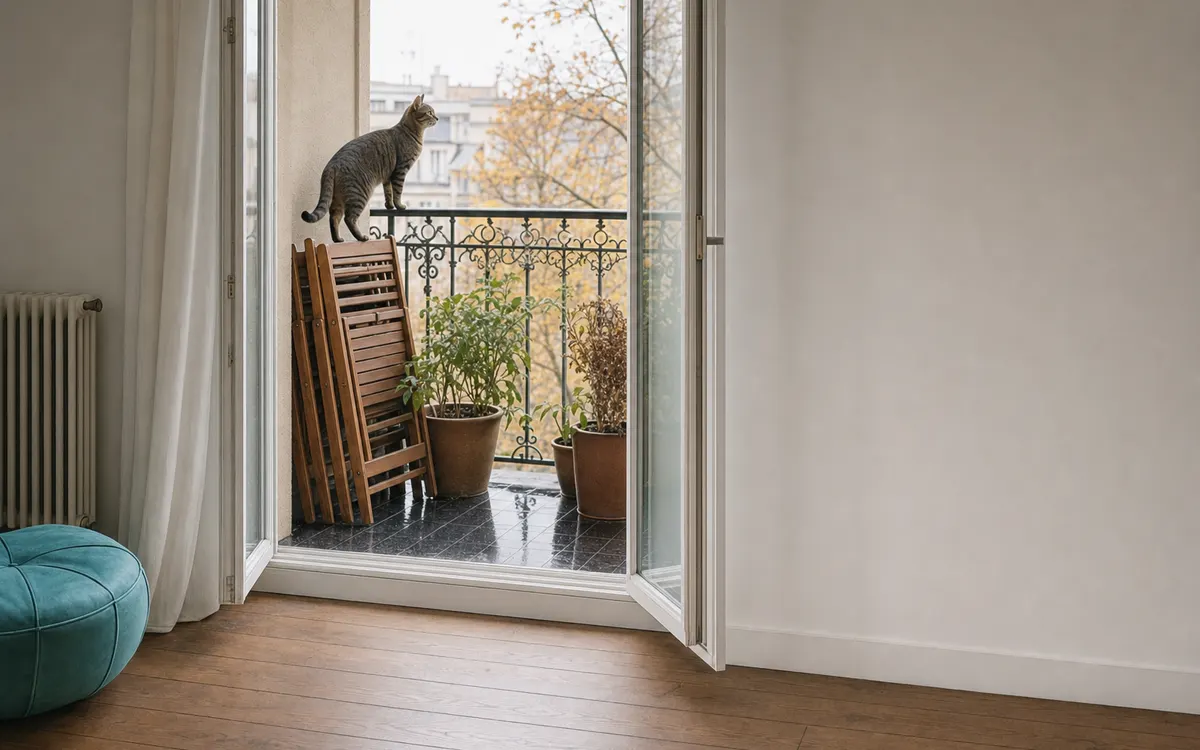
A cat balcony in autumn is not the same place it was in August. Not because the structure changed, but because everything around it did: the summer furniture gets stored, plants come in and others go out, plastic and boxes appear, and the floor spends weeks wet. Each of those changes alters what the cat can climb, where it can slip and what it can reach.
It is a twenty-minute check, once a year. Here is the list.
1. Whatever You Moved This Month
Start here, because this is where almost all the new risks are.
Any object pushed up against the railing is a step. A folded chair leaning on the wall, a toolbox, a stack of plant pots, the parasol stored upright. In summer the cat could not reach the top of the railing; with a box in front of it, now it can.
Practical rule: stand on the balcony and look at the railing from cat height. Anything within an easy jump of it needs moving. A healthy adult cat gets up from knee height without effort.
2. The Wet Floor
This is the risk specific to the season and the one least talked about.
A cat calculates a jump before making it, using the information it has: whatever has always worked on that balcony. Dry, it works. On wet porcelain tile the landing loses grip and the animal slides at exactly the moment it needs to brake.
Nothing needs waterproofing. Two things are enough: knowing that in rain the balcony is a different place, and knowing that if the cat has free access in those conditions, the protection has to be in place rather than relying on the cat being sensible.
3. Railing, Gaps and Edges
Run your hand along the whole railing, section by section:
- Vertical gaps. If the cat’s head fits, the cat fits. And if the head does not fit but the body lying flat does, it fits too. The figure usually quoted is five centimetres, but a young slim cat gets through less.
- The gap at the bottom. The space between the floor and the base of the railing is where most cats get out, because it takes no climbing at all. It gets forgotten constantly.
- Rust and loose fixings. Push the handrails. If something shifts slightly now, it will shift more in January.
- Sharp edges. A metal lip that did not matter in summer becomes a problem if the cat starts using it as a regular route.
4. The Protection You Already Have
If the balcony is already protected, this is the inspection that matters, because netting does not fail all at once: it loosens bit by bit.
- Tension. Push with your palm in the centre of each section. It should give and spring back. If it bags out and stays there, it needs retensioning.
- The perimeter. The failure is almost never in the middle, it is at the corners and edges: where a fixing has come away, where a two-finger gap has opened, where the cat has always scratched at the same spot.
- Fixing points. Check them one by one. The ones exposed to the weather take more punishment than they look.
- Wear. Look for frayed strands, especially at the height where the cat puts its claws.
If you are considering it for the first time, it helps to understand how a balcony gets secured without closing it in, because the assumption that you have to give up light and the view is what puts most people off. And if you rent, there are drill-free options for rented flats that leave no mark on the facade.
An honest note: protection that is properly fitted greatly reduces the risk, it does not eliminate it. You still need to close doors, watch the furniture and never assume the cat will always judge a jump correctly.
5. The Plants That Arrive in Autumn
This is the season when the house fills with chrysanthemums, and chrysanthemum is poor company for a cat. The same goes for ivy, cyclamen and, later, poinsettia and mistletoe.
There is a detail that gets overlooked here: in autumn the cat spends more hours indoors with fewer things to do, so the chance of it nibbling a leaf out of sheer boredom goes up. A plant that sat on the balcony untouched for months can start looking interesting precisely now.
6. Air Conditioning Units and Warm Gaps
Air conditioning units, boxes, furniture with a space behind it and any sheltered corner become attractive as soon as the temperature drops. Two problems: they are places a cat can get stuck in, and they are places a neighbourhood cat can move into, with everything that implies if yours goes out.
Block the gaps that lead nowhere and check that behind the furniture there is no narrow corridor towards the edge.
7. The Door Habit
The classic autumn accident is not a fall: it is a cat shut outside. Someone closes the sliding door because it is getting cold, does not look, and the cat spends hours on the balcony, sometimes overnight.
It is pure habit: look before you close. If other people live in the flat, say it out loud once this week and it sticks.
8. Less Light, More Hours Indoors
With the clocks going back, the cat loses a significant part of its outdoor activity window. That is not a physical risk, but it is why new behaviours show up in November: yowling at odd hours, more pushing at the window, rougher play at night.
Compensating is cheap: two short wand-play sessions a day, a slow feeder and a high spot next to a window with something to watch. A cat with an occupied mind pushes towards the balcony far less.
The List, Short Version
Move whatever you pushed up against the railing. Assume a wet floor changes the grip. Check the gaps, especially the one at the bottom. Tension the protection and inspect its perimeter. Get the seasonal toxic plants out of reach. Block the warm gaps. Look before closing the door. And add an afternoon play session now that it gets dark early.
Twenty minutes in October is worth more than any measure taken in a hurry in January.