
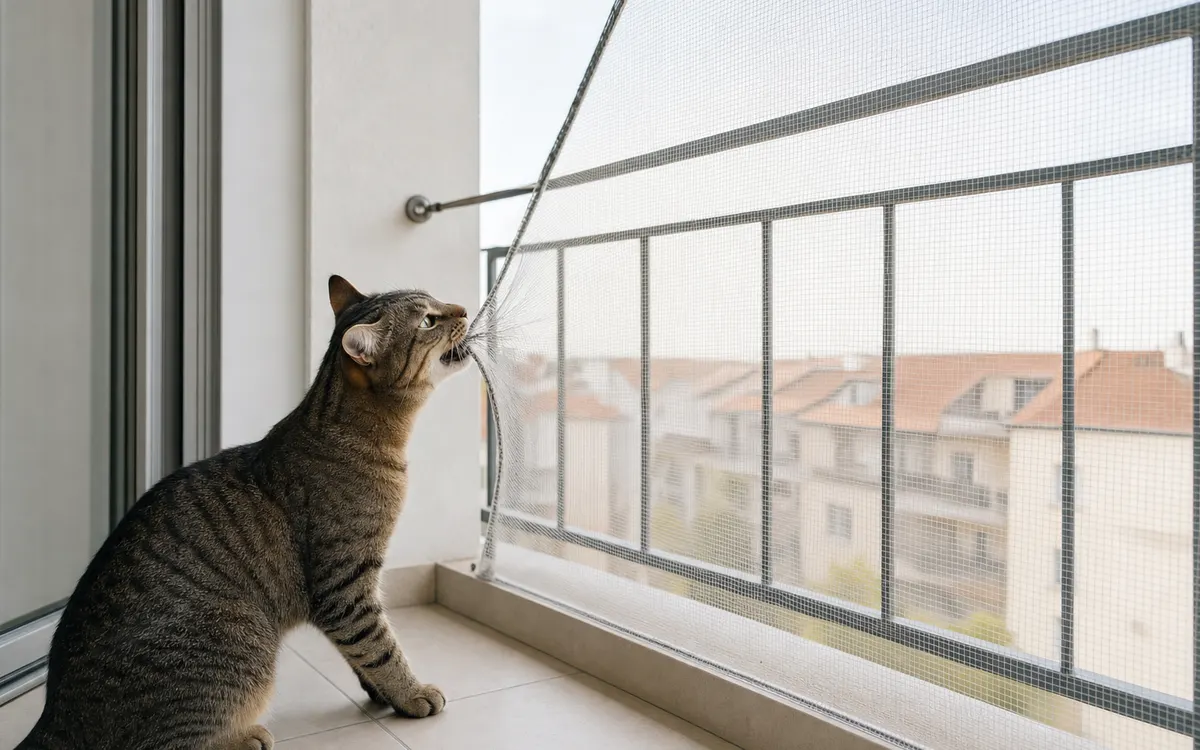
There are cats for which looking at the balcony is enough, and then there are the others: the ones for whom the net is the new favourite toy. They chew it, pull at it, try to climb up it. If yours is the second kind, a thin standard net reaches its limits, and then you need a tear resistant cat net.
Here you will find why some cats bite the net at all, how to tell you need the stronger version, and what you can do beyond the net so your cat stops treating it as a target. Without drama and without miracle claims.
Why cats bite the net
Malice it almost never is. Usually there is boredom, restlessness or plain curiosity behind it. A cat that spends many hours alone, without stimulation and without places to climb, eventually discovers that pulling at the net is entertaining and reliably summons your attention as well.
For others it is the hunting drive: they see a bird or an insect on the other side, and the whole body switches over. Age plays a part too, because young cats explore the world with teeth and claws. Understanding the trigger is the first step, because a stronger net helps, but removing the cause is what really solves the problem.
When you need the reinforced version
Not every household needs the toughest model. These signs point clearly to it, though:
- Your cat bites, chews or pulls at the net persistently, not just occasionally.
- It is large, powerful or notably athletic and climbs effortlessly.
- Several cats live with you, and the net absorbs the wear from all of them at once.
- You have already had to replace a thin net because it was damaged.
- The balcony is on a high floor, where you want every margin of safety you can get.
In those cases a stronger thread decides whether a net lasts years or goes soft after a few months.
What actually makes a net strong
A net does not hold because of one single feature, but because of the sum of several. Thread thickness is the most obvious: the stronger the thread, the less a bite achieves. Then comes the treatment of the material, because a net made for outdoors survives sun, rain and years without going brittle.
Mesh size counts too: a tight mesh stops the cat pushing its head through or hooking its teeth in. And finally the installation. A surface pulled tight, with no pockets and no loose ends, simply offers less to play with. The PetsLovers cat safety net is built with a strong thread for continuous use on balconies and terraces, and the tight mesh makes chewing less appealing from the start. If you rent and still need maximum strength, look at fitting without drilling: it spreads the tension across several points rather than hanging everything on one.
Lower the urge to bite, do not just withstand it
Even with the toughest net, it is better if your cat loses interest in it. What works in practice:
- Offer alternatives for biting and scratching: scratching posts, sturdy toys and an active play session every day.
- Enrich the balcony with a raised spot, a bed or a shelf it can watch from without touching the net.
- Spread activities around the whole flat, so the net is not the most interesting stimulus within reach.
- Do not reinforce the behaviour: if you come running every time it pulls at the net, it learns that this works.
A tough net plus a mentally satisfied cat is the combination that holds up long term.
Fitting and supervision with chewers
With a cat that bites, the installation matters even more. Tension the surface properly, walk the edge regularly, and pay particular attention to the lower section and the corners, the classic favourite spots. You can choose between fixed installation with drilling and the no-drilling version, and the net comes in transparent and black as well as 4 x 3 m and 8 x 3 m, depending on the opening.
And a sentence we keep repeating: no net guarantees one hundred per cent safety. It reduces the risk of a fall considerably, but with a particularly determined cat, regular checks and your supervision remain part of it.