
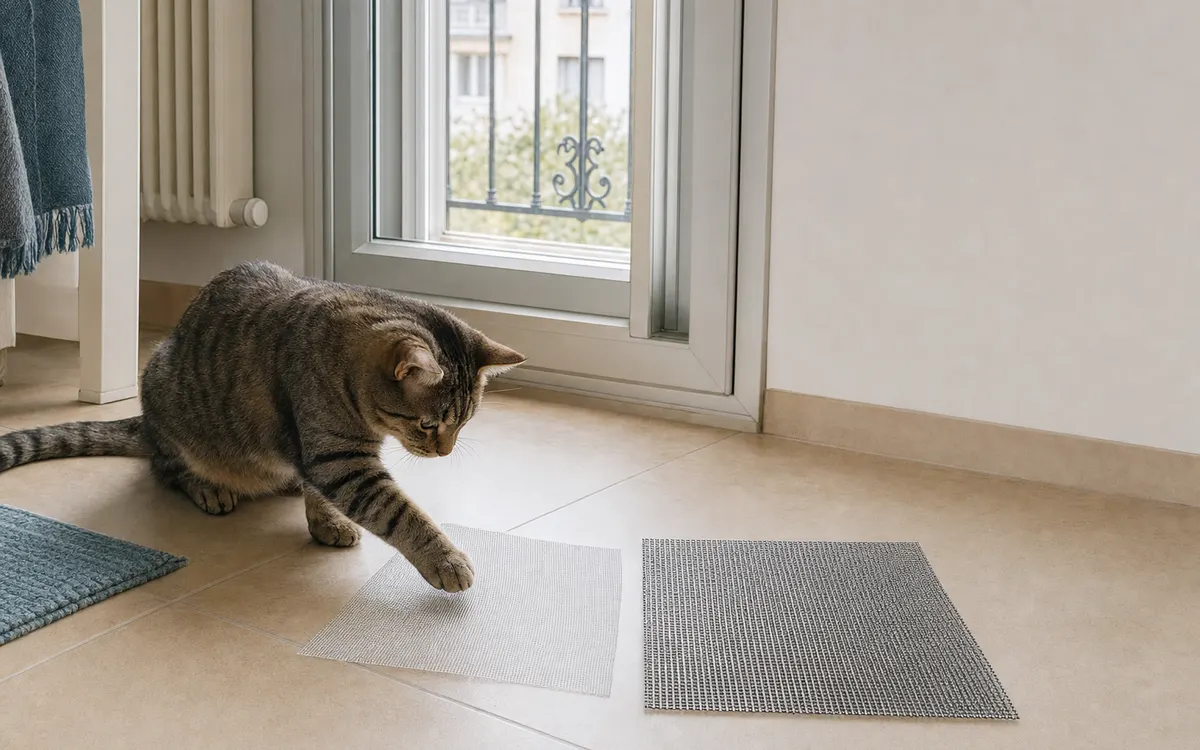
You have a balcony, a terrace or a window your cat sits at more often than you would like, and the most important decision is made: a net is going up. Good. The real problem shows up afterwards, because there is not one solution but two camps, both claiming to be the only safe one: the cat net in nylon or the one in stainless steel.
Here is the level-headed version. Synthetic mesh is not a toy for people cutting corners, and metal is not automatically the answer. They are two solutions for two different situations. Below you will find how they actually differ, when each one makes sense and how to decide without regretting it two months later.
Synthetic mesh: the adaptable solution
What hangs on most balconies is a net made of nylon or UV-stabilised polyethylene. A weave of strong threads with a mesh tight enough that a cat can neither slip through nor push its head through.
Four points explain why it has become the standard:
- Light and discreet. It takes barely any view and does not visually overload the balcony.
- Easy to fit. In many cases you need no drill at all, which makes it the obvious choice in a rented flat.
- Adaptable. It follows crooked openings, curved railings and windows in unusual formats.
- Affordable. You secure a whole balcony without a major investment.
What to look for in a synthetic net
Not every synthetic net is the same, and that is exactly where the trap lies. A thin net off a hardware shop shelf survives two summers and then frays in the sun. What makes the difference is the thread thickness, the UV treatment and above all the reinforced border, because that is where a cheap net gives way first. So it is worth looking for a model built for continuous outdoor use, rather than only at the price per square metre. Which versions exist and what they are for is covered in the overview of the cat safety net for balconies and windows.
Stainless steel: the rugged solution
Nets in stainless steel, usually as a cable weave or a rigid grille, are in a different league for sheer resistance. If your absolute priority is that the barrier survives knocks, persistent chewing and many years of weather, metal delivers exactly that.
Its strengths:
- Extreme durability. It shrugs off abrasion, weather and years better than almost any fabric.
- Insensitive to bites and claws. Made for particularly determined or very powerful cats.
- A solid feel. It reads as a fixed part of the building rather than a retrofit.
What steel costs in practice
That ruggedness brings drawbacks you should know about first:
- A more demanding installation. It usually needs a fixed substructure, drilling and occasionally a professional. For rented flats it is rarely practical.
- Less flexible. Crooked openings and curved railings are harder to close cleanly.
- Higher costs. Material and labour weigh considerably more.
- Visual presence. Depending on the version it reads cooler and more visible than a fine mesh.
How to decide properly
Forget the question of which is better in general. The right question is which is better for your home. Four answers are enough:
- Do you rent or own? If you rent and want no discussion with the landlord, a quality synthetic mesh serves you best.
- What is your cat like? A calm, medium-sized cat is fully covered by a good synthetic net. A very large, powerful cat that chews persistently at everything argues for metal.
- What does the opening look like? Curves, crooked angles and large areas are better solved by the adaptability of the mesh.
- What is your budget? Synthetic secures more area for less money, steel is the larger and more permanent investment. There is a guide to this in the prices by size.
For the vast majority of households with a cat, a reinforced synthetic net, fitted properly, offers the best balance of safety, looks, price and effort. Steel remains the sensible choice in special cases with maximum strain, or when you want a permanently built-in solution from the start.
In the end, though, what counts is less the material than the quality of the mesh and an installation with no gaps. An excellent net that sits badly protects no better. If you go for mesh, take a version designed for continuous outdoor use, and follow the instructions exactly when you tension it. How discreet the result can be is shown by the transparent cat safety net, which you barely notice from a distance.
An honest note to close: no net, whatever the material, removes the risk entirely. It lowers the chance of a fall or an escape considerably, but it does not replace your attention, especially in the first few weeks.