
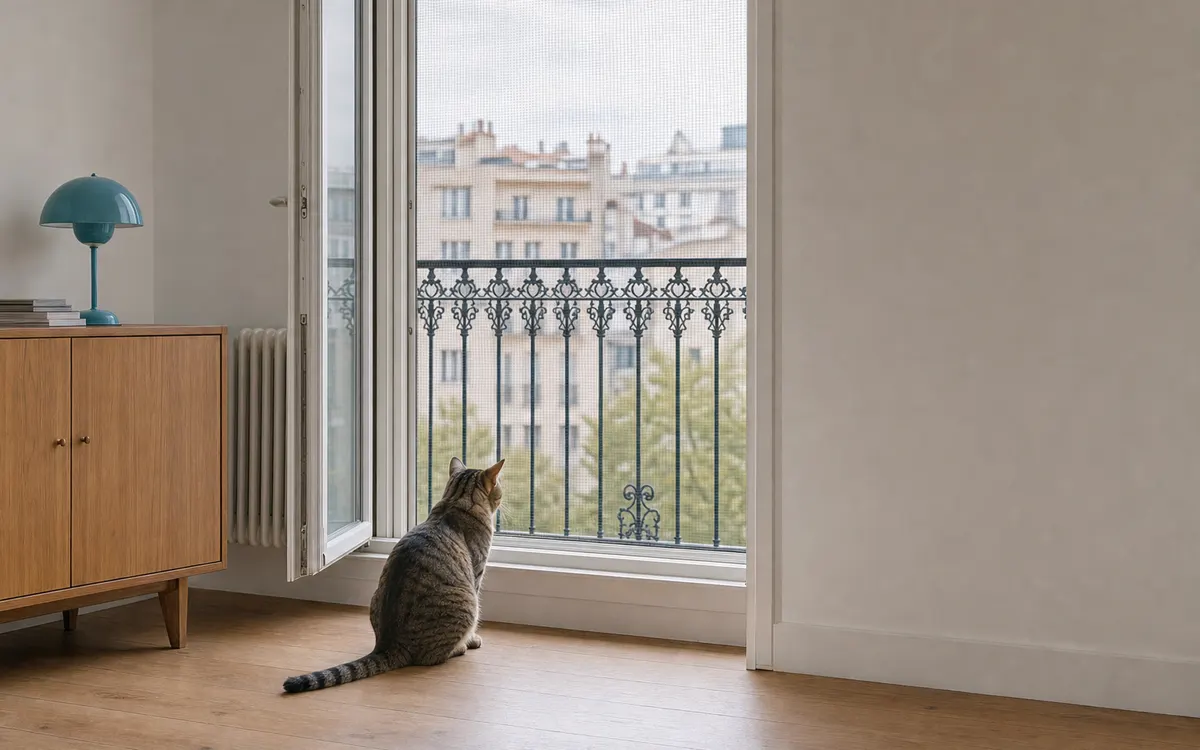
Your cat jumps onto the windowsill, looks down from the fifth floor, and your stomach tightens. Or your dog puts its paws on the balcony railing to watch the street. An everyday scene and a dangerous one at the same time, and if you are reading this you have felt that jolt at least once. The good news is that you do not have to choose between shutting your pet indoors and living in permanent anxiety.
Here you will find why your pet seeks height, which risks are real and what you can do today so that pet, balcony and safety belong in the same sentence. No miracle claims, just concrete measures that genuinely lower the risk.
Why animals seek height
Before you solve the problem it helps to understand it. Leaning out is not a whim or an act of defiance. It answers real needs.
- Curiosity and territory: cats especially monitor their surroundings from high points. A balcony is the perfect lookout over birds, cars and people.
- Stimulation: a bored animal goes to windows and edges, because that is where the interesting things happen.
- Temperature and light: the sun on the terrace and the breeze at the window pull in any animal.
- Hunting: a pigeon or an insect on the other side of the glass triggers the chase impulse, and that is exactly where balance is lost.
The core of it is this: your pet does not assess danger the way you do. A cat trusts its own balance enough to venture onto edges where a mistake is expensive. Not through negligence, but because its brain does not process height as a threat.
The real risk of falls
The belief that cats always land on their feet persists. It is a dangerous myth. They do have a righting reflex, but that reflex does not prevent injuries: a fall from a high floor can cause fractures, internal damage or worse. In dogs the risk is even more immediate, because they do not have that reflex at all.
And the problem is not extreme height alone. A tilted window, a railing with wide gaps between the bars, or one distracted moment chasing a bird are enough. Most falls happen in ordinary situations, not dramatic ones. That is precisely why prevention is worth so much: it works where the risk hides. What veterinary medicine calls this pattern of injuries in cats is covered in high-rise syndrome.
What you can do today
Here is the practical part. Depending on your home and your animal, you will combine more than one of these.
1. Close the edge physically
The most effective measure is the most obvious one: if your pet cannot reach the edge, it cannot fall. A safety net for balconies and terraces creates a barrier that lets light and air through but not your cat. It solves the problem at the root, on balconies, terraces and windows. How to tension it evenly is covered in the fitting guide.
2. Close the blind spots
- Check the windows: tilt-and-turn windows are especially dangerous, because a cat can get trapped in the gap at the top.
- Check the gaps in the railing. If your pet’s head fits through, the problem fits through.
- Do not leave furniture or planters that act as a step towards the edge.
3. Redirect the instinct
Give your pet a better reason not to fixate on the edge. A tall scratching post by the window, daily play, a food puzzle or simply a safe lookout spot indoors move the curiosity somewhere without risk. An animal whose needs are met climbs less out of frustration.
4. Supervise the first weeks
If you have just moved or taken in an animal, do not assume it knows its limits. Watch it on the balcony and terrace until you know how it behaves, and until then do not leave it out there alone.
Mistakes to avoid
- Trusting that nothing has happened so far: the past guarantees nothing, least of all when the surroundings change.
- Leaving the window open just a crack: a small opening is enough for a determined animal.
- Thinking this is only a cat problem: small, curious dogs lean out and jump as well.
- Improvising wobbly barriers: a badly fixed solution creates false confidence, and that is sometimes worse than nothing.
If you live high up and your pet seeks the edge, combine a reliable physical barrier with daily enrichment. Start with what gives you peace of mind from day one, and work in parallel on making the home itself more interesting.