
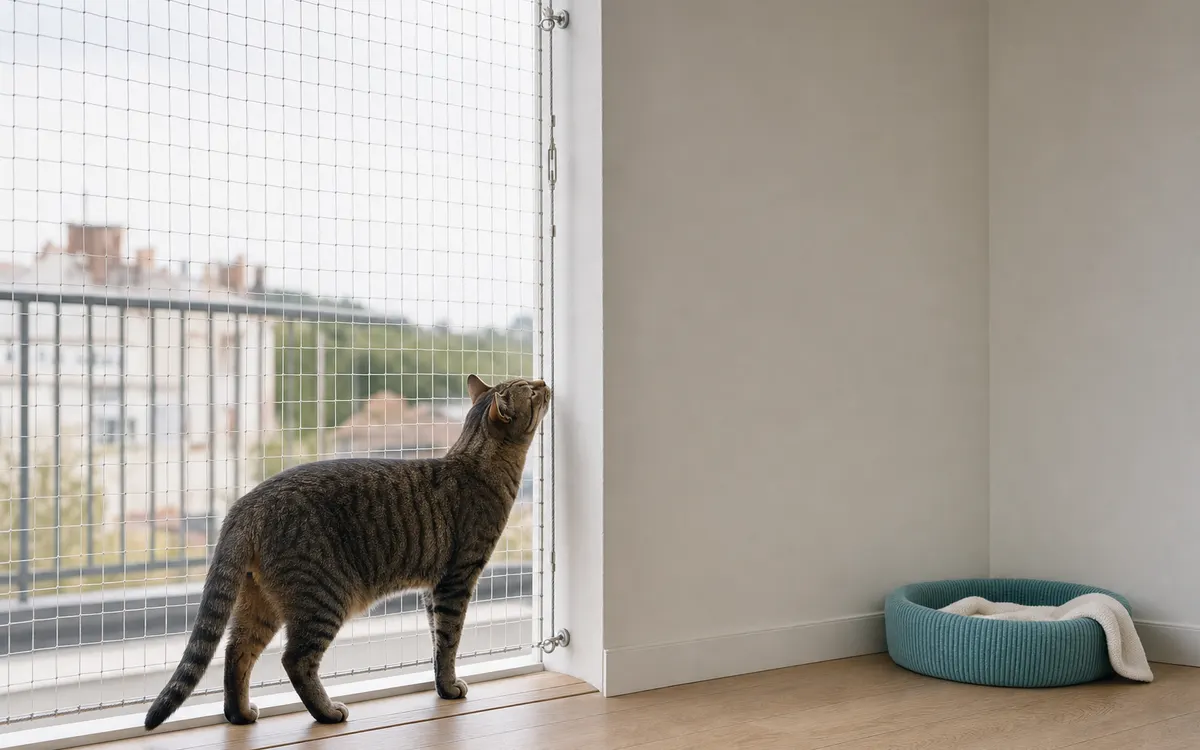
A roof terrace is every cat’s dream: sun, height, birds to watch and metres to patrol. The catch is that this same open space is where most incidents happen. No cat jumps into thin air on purpose, but it misjudges a jump, chases a fly to the edge or slips on a wet railing. At that height there is no second attempt at a mistake like that.
If you have a large terrace or a top-floor flat with a long edge, a cat net for a roof terrace is not the same thing as one for a small window. There are more metres to close, more fixing points to solve and more wind to withstand. It is still doable, without sacrificing the view or turning the terrace into a cage.
Why large areas follow different rules
On a standard balcony you close three or four metres and you are done. On a large terrace the task looks different: long edges, corners, pillars, glass or masonry parapets, and sometimes sections with no fixing point nearby. Every extra metre is a metre on which your cat can look for the weakest spot.
Then there is the wind, which is almost always stronger at that height. A net pulled tight shrugs off gusts, a loose one becomes a sail. So before you buy anything, it is worth looking at the space the way your cat looks at it: searching for the place it could get through.
What to sort out before buying
Measure the whole edge
Do not estimate. Measure each section separately, corners and changes in level included. On large terraces, buying too little material is the most common mistake, and an unclosed gap is exactly where your cat will try. Note the height you want to cover too: many cats climb, and securing up to the handrail is then not enough.
Find the fixing points
This is the point most people underestimate. On a large terrace you need solid anchors at several places, not only at the ends. Check what you have available:
- Walls and low walls where eyelets or brackets can be set.
- Metal or masonry railings you can tension against with ties or cables.
- Ceilings, beams or awnings as an upper fixed point.
- Sections with no anchor nearby, for which you need a perimeter tension cable running along the edge to carry the net.
If you rent or your building has strict rules, look for systems that avoid drilling into the facade. Tension solutions between floor and ceiling hold well, as long as you re-tighten them occasionally.
Choose the right material and mesh
For outdoors and for height, what counts is a net that survives sun and wind for years. Watch three things:
- A tight mesh. With young or slight cats, a mesh that is too open lets the head through, and the rest follows.
- UV resistance. On a roof terrace the net stands in direct sun for many hours. Without treatment it ages faster.
- Colour. Transparent or a fine black disappears at a distance and leaves the view clear. The black version blends particularly well with dark railings.
The mistakes that cost you a fright
- Leaving small gaps, in corners or beside planters. A cat fits anywhere its head fits.
- Not tensioning enough. A loose surface billows in the wind and becomes a hammock to climb.
- Closing only the railing and forgetting the top with cats that climb.
- Anchoring to unstable elements, such as a planter or a piece of furniture that moves.
- Never checking. Sun, wind and claws take their toll on any material, and a regular round saves you surprises.
Fitting: work in sections
On large areas the trick is to split the edge into manageable sections and fit them one at a time, tensioning as you go. Start with the upper cable or upper bracket, hook the net on and pull it down until it sits firm and forms no pockets. Close the corners carefully, they are the classic weak point. The basics are in the fitting guide, and they apply to a terrace exactly as they do to a small balcony.
For long edges the continuous 8 x 3 m size is usually the better choice, because you do not have to join small pieces and the tension stays even. You will find both sizes in the cat safety net overview.
In the end what matters is not the net alone, but how you anchor and tension it. A simple net fitted properly protects better than an expensive one fitted badly. And this belongs to the honesty too: it lowers the risk a great deal, it does not remove it.