
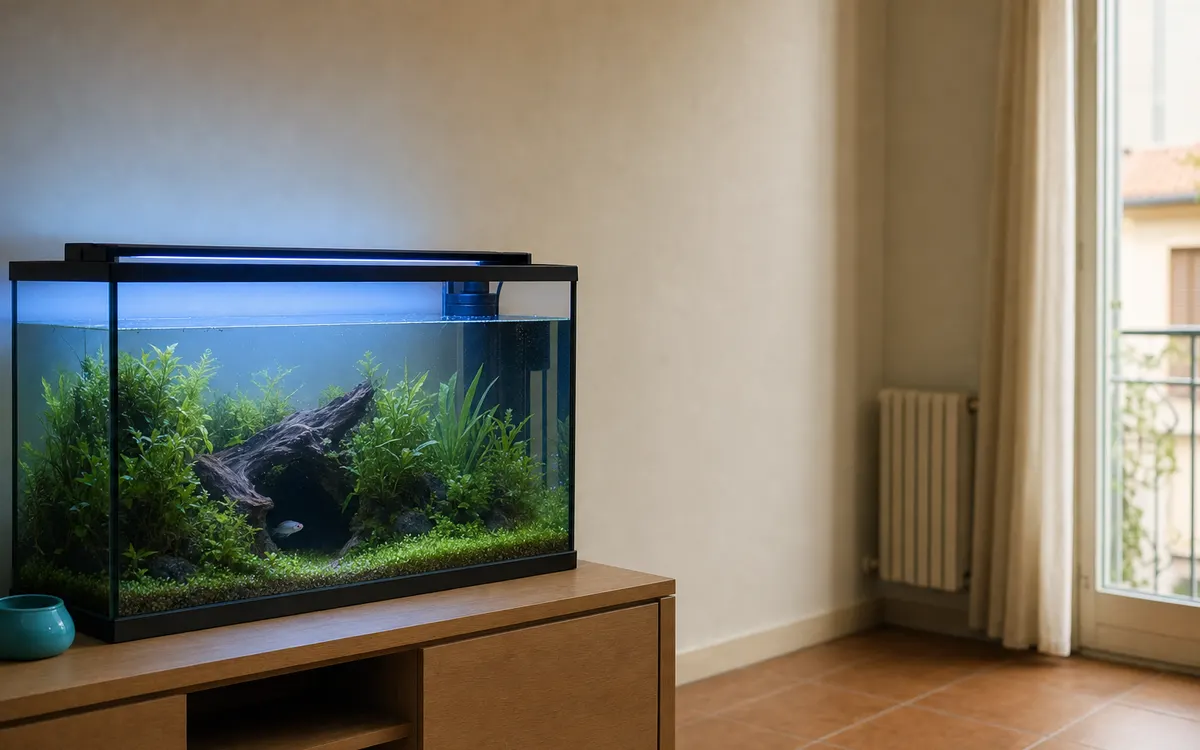
It is one of the classic disappointments of home fishkeeping: you set the tank up, choose attractive fish, release them, and three days later not one is visible. The most common reaction is to take out the wood and plants so they have “nowhere to hide”. That is precisely the opposite of what works.
Fish hiding in a tank are not always in trouble. But when they are, the cause is almost always one of four things.
First: Rule Out That It Is Normal
Before hunting for problems, check two obvious things that get skipped constantly.
What species do you have? A good share of popular fish are crepuscular or nocturnal. Kuhli loaches spend the day buried. Many plecos and other catfish do not appear until the lights go off. Bottom dwellers generally prefer dim conditions. If you bought a fish that lives under a rock in the wild, it will live under a rock.
How long has it been there? A newly introduced fish needs one to seven days to settle. It has been through capture, a bag, transport and a change of parameters. Hiding during those days is a healthy response, not a failure.
If your fish is diurnal, has been there more than two weeks and still does not come out, read on.
Cause 1: Water Quality
This is always the first thing to rule out, and the one that resolves the case most often.
Ammonia or nitrite above zero irritates the gills. A fish that cannot breathe properly reduces activity, sits still on the bottom or pressed into a corner, often with fins clamped against the body. It reads as shyness and it is physical discomfort.
Test ammonia, nitrite and nitrate before touching anything else. It is quick, cheap and it saves months of guesswork. Be especially suspicious if the tank has been running less than two months, if you cleaned the filter thoroughly recently, if several fish went in at once, or if feeding has crept upwards.
Cause 2: Not Enough Cover
Here is the paradox that surprises nearly everyone: the more refuges you offer, the more the fish show themselves.
A fish assesses risk constantly. In a bare tank the entire volume is exposed, so the animal freezes in whichever corner looks least bad and stays there. In a tank with tall plants, wood and shaded areas there are routes: the fish comes out to explore because it knows cover is two fin strokes away.
What to add, in order of effectiveness:
- Tall or floating plants. Floating plants are especially powerful because they break the overhead light, which is what most unsettles fish from shaded waters.
- Wood and roots that create gaps and corridors.
- Caves and terracotta pots for bottom-dwelling species.
- Genuinely shaded zones, not just decoration pressed against the glass.
One more thing: brightly lit tanks with no plant cover are uncomfortable for many tropical species that live under canopy in their home rivers.
Cause 3: Hierarchy and Harassment
When only one or two fish hide and the rest behave normally, the cause is usually social.
How to see it: sit a couple of metres away, without approaching the glass, and watch for half an hour straight. Look for chasing that always involves the same individuals, nipped fins, a fish that eats last or does not approach the food at all.
The situations that cause it:
- Incomplete shoals. Species that need six, eight or ten individuals kept in groups of three. A short shoal generates stress and drives internal aggression. It is the most common mistake and the easiest to fix.
- Sex ratio. In several livebearer species, one male per two or three females prevents constant harassment of a single female.
- Incompatible tank mates. A territorial fish in a small space turns half the tank into a no-go zone.
- No visual barriers. With no plants or decor to break the line of sight, the dominant fish sees the subordinate from anywhere and chases it. Adding structure reduces aggression without changing any fish.
Cause 4: The Environment Outside
It gets forgotten because it is not inside the glass:
- Tank in a thoroughfare. A tank in a hallway or beside a door gets startled all day.
- Abrupt lights on. Going from total darkness to full power is a shock. Turning the room light on first, or using a timer with a gradual sunrise, changes behaviour considerably.
- Tapping the glass and fast movement in front of it. Obvious, and still happening.
- Vibration. A wobbly stand, a speaker nearby or a rattling filter transmit far more than you would think.
- Apparent predators. A cat that sits watching the tank every afternoon is, from the fish’s point of view, exactly what it looks like.
The Plan, in the Right Order
- Test the water. Ammonia, nitrite, nitrate. If something is off, that comes first.
- Check species and settling time. There may be nothing to fix.
- Add cover and tall plants, especially floating ones. Never remove them.
- Watch for half an hour in silence to rule out harassment.
- Complete any short shoals.
- Lower the light intensity or add plant shade.
- Review the outside environment: foot traffic, abrupt lighting, vibration.
When Hiding Stops Being Behaviour
If hiding comes with clamped fins, rapid breathing, marks or white spots, loss of colour, rubbing against the decor, or the fish resting on the bottom without swimming, this is no longer a behavioural problem. At that point isolate in a hospital tank if possible, review parameters thoroughly and get a diagnosis before treating anything blind.
A hidden fish is information. It is almost always saying the water is not right, that it lacks refuge, or that someone is not letting it live in peace. Taking away its hiding places answers none of the three.