
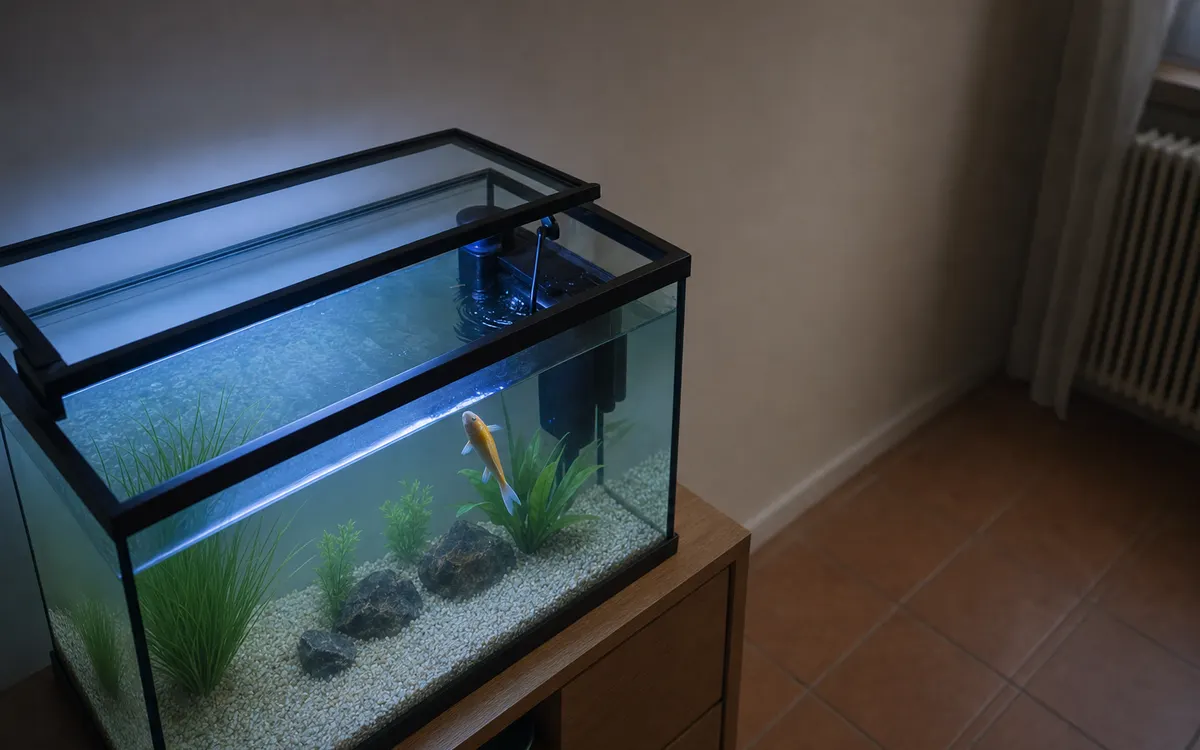
There are few worse moments in this hobby than finding a fish on the floor in the morning. The usual reaction is to assume it was bad luck, a clumsy leap. It almost never is. A fish that jumps is usually telling you something, and it is worth listening, because the jump is the symptom and not the problem.
The Five Real Reasons
1. Water quality. This is the first to rule out and the most frequent. Ammonia or nitrite above zero irritates the gills, and a fish that cannot breathe properly tries to get out of there. A tank that is not fully cycled, a filter cleaned too thoroughly, or excess food breaking down can cause it within days.
2. The tank is too small. A fish that has grown larger than the shop suggested, or a tank that was never the right size for that species, creates constant stress. Jumping is an attempt to move somewhere else.
3. Harassment from another fish. In a tank with hierarchies or incompatible species, the fish at the bottom of the social order lives on the run. If it has too few hiding places, the only escape route left is upwards.
4. Sudden startles. Switching the tank light on abruptly in a dark room is a considerable shock. So are knocks on the glass and sharp movements in front of the tank. Many jumps happen at exactly that moment.
5. Because their species jumps. For some fish, jumping is normal behaviour: they hunt insects at the surface or move between pools. Killifish, hatchetfish, danios, loaches and kuhlis fall into this category. With them a lid is not a precaution, it is basic equipment.
How to Close the Gap Without Ruining the Tank
The obvious solution is to cover the tank, and this raises the most common worry: will it run out of oxygen?
No, not if it is done properly. Gas exchange depends on surface movement, not on the tank being open to the air. A filter that gently ripples the surface maintains oxygenation perfectly with the tank covered.
What does matter is how you cover it:
- Glass lid: the most effective, though it reduces evaporation somewhat and needs limescale cleaning.
- Fine mesh or netting: lets more light and air through, widely used in planted tanks with powerful lights.
- The gaps are the critical part. The usual failure is not the absence of a lid but a lid with a two-finger gap where the filter tubes or heater cable pass through. That is exactly where they get out. Covering those gaps with mesh or offcuts takes five minutes.
Lowering the water level by a few centimetres helps as a supporting measure, but not as the only solution: a motivated fish jumps considerably higher than we assume, and dropping the level a lot reduces usable volume and concentrates waste, worsening what is usually the original cause.
The Right Order of Actions
If a fish has jumped, the sequence is this:
- Cover the tank today, even temporarily. It prevents the next jump while you investigate.
- Test the water: ammonia, nitrite and nitrate. If either of the first two is above zero, that is the most likely cause.
- Watch for half an hour without standing too close. Is one fish chasing another? Does any have nipped fins or hide permanently?
- Check the adult size of your species and compare it with your tank. It is a figure many shops leave out.
- Add hiding places if there is social tension: tall plants, wood, shaded areas. A fish with somewhere to shelter stops looking for the exit upwards.
If You Find One Out of the Water
If it is still moving or breathing, return it to the tank as soon as possible, with wet hands so you do not damage its slime coat. Then watch it for a few hours: fish that have been out can develop infections in the damaged skin or respiratory problems.
And do not leave it there. The jump has already given you the information: something inside the tank pushed it to try. Covering without fixing the cause only keeps the problem in the water, where you cannot see it.