
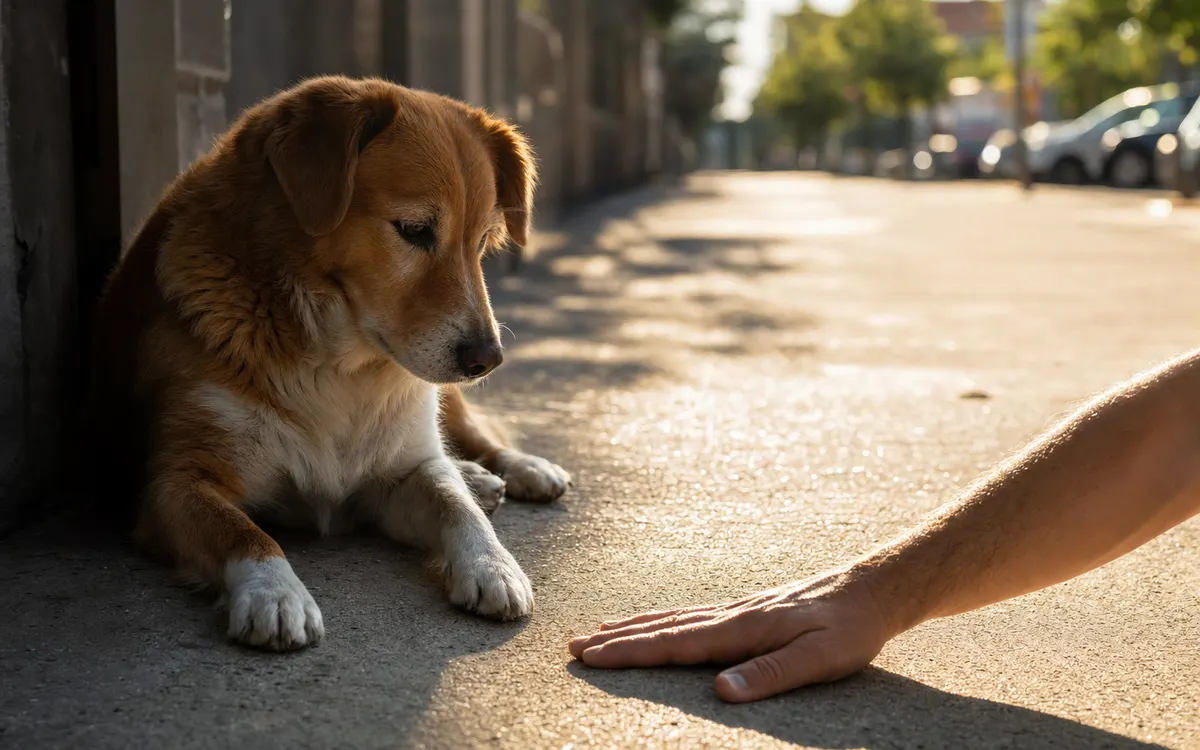
There is one very specific summer trap: checking the temperature on your phone, seeing 28 degrees, and assuming you can walk as normal. The problem is that the number measures the air a metre and a half up, and your dog doesn’t walk through the air. It walks on a surface that has been absorbing sun for hours.
At 28 degrees of air temperature and in direct sun, dark tarmac can go past 50. That isn’t discomfort: it is a contact burn.
The Seven-Second Rule
It is the most useful check there is and it needs no equipment. Before heading out, or on the first stretch of the walk, place the back of your hand on the tarmac and count to seven.
If you have to pull it away sooner, your dog can’t walk there. Its pads are tough skin, not a rubber sole: they insulate a little, but not enough for a surface at that temperature, and much less with the animal’s weight keeping the contact.
Use the back of your hand, not the palm: the palm is more hardened and will give you an over-optimistic reading.
Why the Hour Misleads More Than the Temperature
Tarmac doesn’t cool down when the sun sets, it cools well afterwards. It has been storing heat all afternoon and releases it slowly. That is why a walk at eight in the evening in mid-August can still be a bad idea, even if the air feels cooler and there is shade.
In practice, that leaves two reasonable windows in summer:
- Very early, before the sun has spent hours on the street. The safer of the two.
- After dark, once the ground has had real time to release the heat.
And one decision worth more than any hour: choosing the surface. Grass, earth and continuous shade change the picture completely. A park at seven in the evening can be perfectly safe while the pavement opposite is still burning.
The Signs You Have Gone Too Far
Dogs don’t always complain in a way we read quickly, so it helps to know the pattern:
- It limps or suddenly changes its gait for no apparent reason.
- It stops, sits, or refuses to go on.
- It licks its paws insistently, more than usual.
- It lifts its paws alternately, as if looking for somewhere to put them.
- It heads urgently for shade or the kerb.
If you see this, the first thing is to get it off the hot ground: into shade, onto grass, or in your arms if it is small. Then look at the pads. Redder or darker areas, lifted skin, or blisters are a reason to call the vet, not to wait and see whether it improves.
What Actually Helps and What Only Looks Like It
Genuinely helps: changing the time, changing the route to grass and shade, shortening the walk and making up for the energy at home with mental games, and always carrying water.
Half helps: boots, if the dog tolerates them and they are properly secured; protective waxes, which create a very thin barrier. Neither turns 50-degree ground into safe ground, and relying on them is exactly the mistake that causes burns.
Doesn’t help: wetting the paws before going out (it dries in minutes), or assuming a dog with hardened pads is safe. They do toughen with use, but not that far.
The Heat Doesn’t Stay Outdoors
One detail that gets overlooked: on the hottest days the house changes too. Windows and balcony doors get opened that stay shut the rest of the year, and that shifts the map of risks indoors, especially if there is also a cat in the household. It is worth checking those openings before the first heatwave, not after the first scare.
Out on the street, though, the rule is short and remembers itself: if you can’t leave your hand down for seven seconds, it can’t walk. That is the only thing you need to check before you go out.