
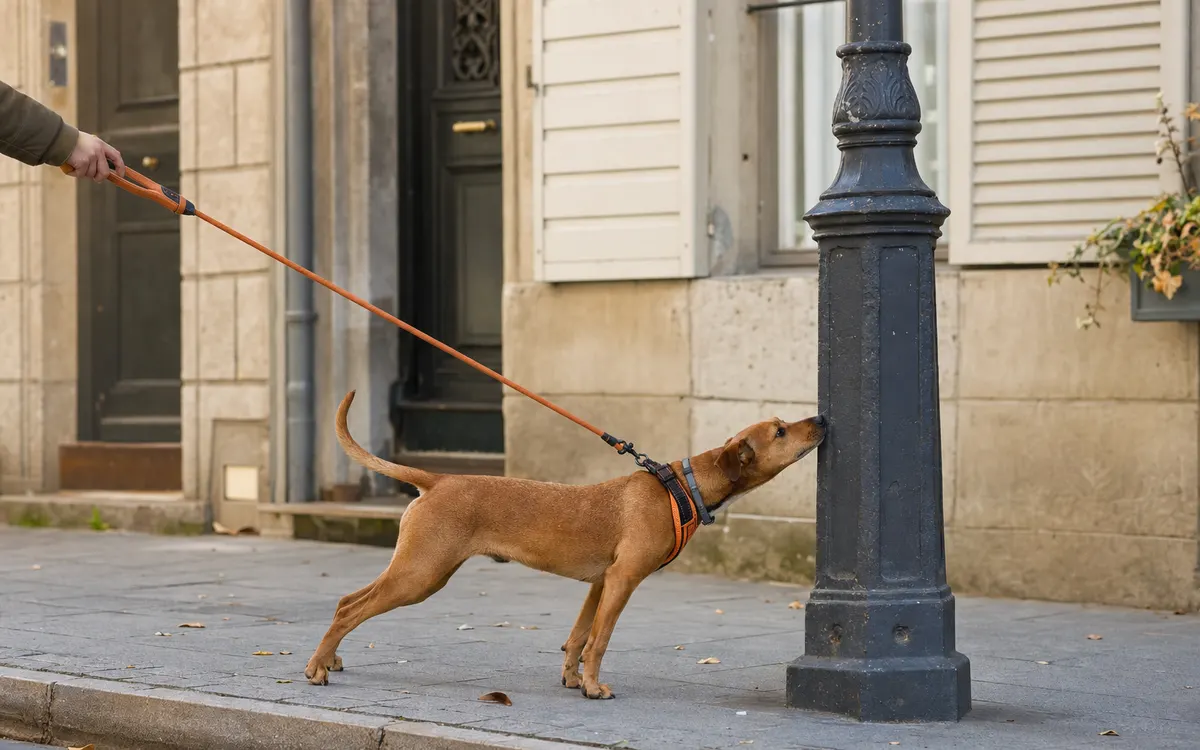
It is by far the most frequent complaint about living with a dog: the walk turns into a tug of war, you get home with a sore shoulder and the feeling that the dog is walking you. It is also one of the worst explained problems, because the popular explanation (that it wants to dominate you) is false and leads to solutions that make things worse.
Why It Actually Pulls
There are three reasons, and none of them involve rank.
Because it works. This is the main one. The dog wants to reach the park, that tree, that smell. It pulls, and even if you resist, the pair of you end up moving forward. From its point of view, pulling produces the desired result. Any behaviour that produces results gets repeated.
Because our pace is glacial. A dog’s natural walking rhythm is considerably faster than our strolling pace. Asking it to match our speed is asking it to hold back constantly, and a tight leash is what happens when it cannot.
Because the walk is its information session. Sniffing is not an indulgence: it is how a dog reads the world. A walk where it cannot stop to sniff is a frustrating walk, and frustration turns into tension.
The Methods That Fail (and Why)
Corrective jerks on the leash. They stop the moment, they teach nothing. And the dog may associate the pain not with pulling but with whatever it was looking at: another dog, a cyclist, a child. That is how a leash problem becomes reactivity.
Prong or choke collars. They work because they hurt. The risks are concrete: trachea and cervical injuries, especially in small and flat-faced breeds. And there is still no information for the dog about what it should be doing instead.
Retractable leads in the street. They teach exactly the opposite of what you want: that constant tension on the leash makes the leash longer. It is continuous reinforcement of pulling, plus a hazard on pavements and at crossings.
Shouting the dog’s name. If its name is used for telling off, it stops being a positive attention cue and becomes a signal worth ignoring.
What Does Work
The logic is simple: pulling stops producing results, and walking on a loose leash starts producing them.
1. A tight leash stops the walk. The moment the leash goes tight, you stop. No pulling back, no telling off: you stand still, like a lamppost. When the leash slackens, even because the dog turned to look at you, the walk continues. It is slow and boring for the first few days. It is also what makes the dog understand the rule.
2. Reward the loose leash, not just the absence of pulling. When it walks beside you with the leash relaxed, give it something: a small piece of food, continued progress towards what it wants, a word. Many owners only react when the dog does something wrong, so the dog never gets any information about what is right.
3. Change direction. Instead of stopping, turn and walk the other way when it pulls. Not as punishment, but because it teaches the dog to keep track of where you are going. It works very well with young, high-energy dogs.
4. Set aside free sniffing time. Mark part of the walk as “you decide here”: a long leash in a safe area and time to sniff without hurry. A dog that has been allowed to sniff arrives far less frustrated at the stretch where you do need it beside you.
5. Suitable equipment. A harness with a front clip to spread the force and gain control while you train, and a fixed leash of medium length. The harness does not teach, but it prevents damage during the process.
The Rule That Decides Everything
Consistency matters more than technique. If out of ten walks you stop at the first sign of tension on nine and pull through on one because you are late for work, you are not teaching “don’t pull”: you are teaching “sometimes it works, keep trying”.
In learning, intermittent reinforcement is the hardest to extinguish. It is the same reason slot machines are addictive. So the realistic commitment is not to be perfect but to avoid breaking the rule precisely on the rushed days: on those days, a short well-run walk beats a long one spent pulling.
When This Is Not a Training Problem
There are two situations where leash work alone is not enough:
- If the dog only pulls towards specific things (other dogs, cars, people) while barking or tensing up: that is no longer pulling, it is reactivity, and it needs a different approach.
- If the pulling comes with excessive panting, coughing or retching: get the trachea and airways checked by a vet before continuing training, especially in small or flat-faced breeds.
In both cases, and also if you have spent months trying with no progress, a trainer qualified in positive reinforcement saves a lot of time and stops the problem becoming entrenched.
Walking on a loose leash is not obedience: it is an agreement. The dog keeps the leash slack because moving that way works better than pulling, and for that it has to genuinely work better, on every walk.