
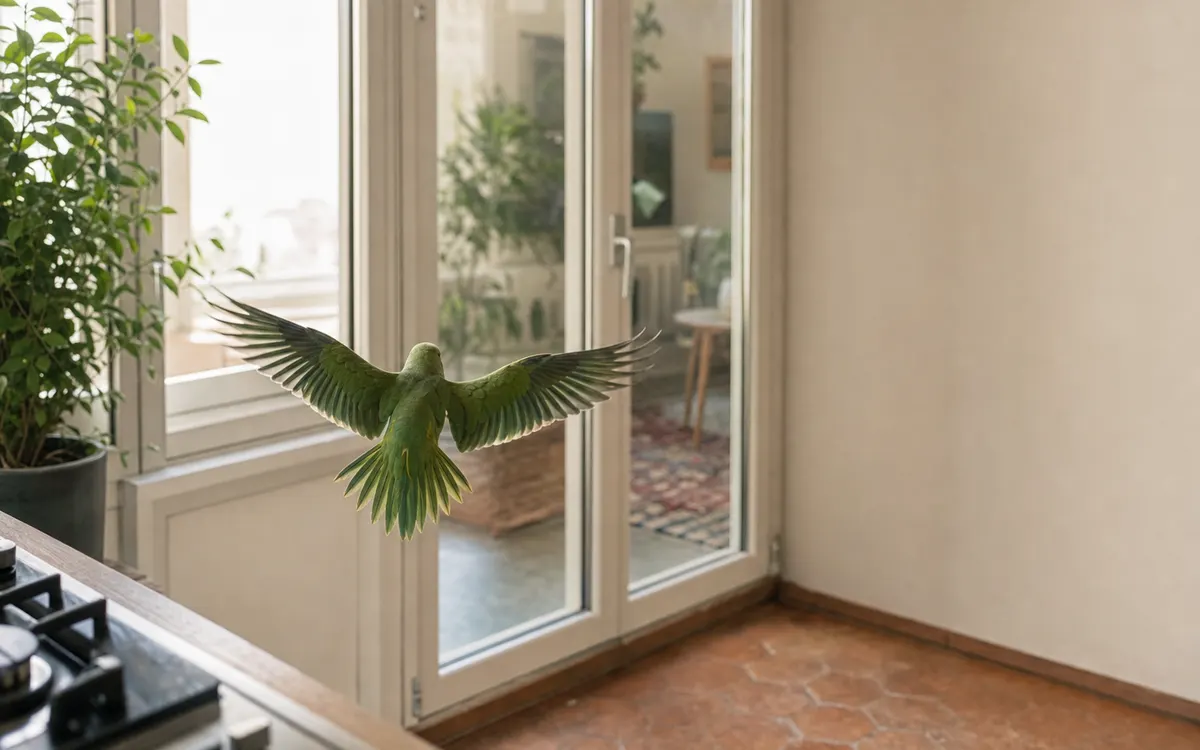
You let your bird out into the living room for a while each day, as you should: flying is a need, not a treat. And the living room looks like a safe place, because for you it is. The problem is that a bird does not live in the same house you do. It lives in a version of that house where the air, the reflections and the gaps mean something completely different.
These are the real dangers, ordered from most serious to least known.
The Kitchen, and Non-Stick Pans Specifically
This is the most serious risk and the one almost nobody has on their radar. Non-stick coatings, when overheated, release fumes that have no noticeable effect on us and kill a bird within minutes.
This is not forum exaggeration: a bird’s respiratory system is built to extract oxygen with extremely high efficiency, and that same efficiency absorbs anything else in the air. It is why canaries were historically taken down mines.
The practical rule allows no nuance: while anyone is cooking, the bird is not in the kitchen or in a room connected to it. The same applies to self-cleaning ovens, coated irons, and some new heaters the first time they are switched on.
Everything That Gets Breathed In
The kitchen is not the only source. Birds react badly to:
- Air fresheners, diffusers and scented candles.
- Cleaning aerosols, hairspray and spray deodorants.
- Cigarette smoke, including what lingers on clothes.
- Fresh paint and DIY products.
None of this calls for panic, but it does call for a simple rule: if you are going to use something strongly scented, the bird leaves that room and it is aired properly before the bird comes back.
Glass, Mirrors and Windows
A bird does not understand glass. It sees the reflection of the room, or it sees outside, and flies there at full speed. Collisions with windows and mirrors are an extremely common cause of trauma.
Before a flight session, lower the blinds halfway or draw the net curtains. With a large mirror, cover it or take it out of that room.
Then there is the open window, which is a different problem entirely: escape. A pet bird that gets out of a window rarely comes back, because it cannot navigate or feed itself outdoors. Before opening the cage, check that every window and external door is shut, and tell whoever lives with you that the bird is out.
Water and Open Containers
It sounds minor and it is not. A pot of water, a mop bucket, a toilet with the lid up, even a tall glass, are genuine traps: a soaked bird cannot fly and does not always manage to get out.
Before letting it out: lids down, pans away, buckets emptied.
Fans, Doors and People
A ceiling fan left running is one of the few things in an ordinary home that causes instant death. It goes off before the cage opens, every time.
Doors are the second cause: somebody walks in or out without knowing the bird is loose and catches it as it closes. That is why flight sessions work better when the whole household knows they are happening.
Plants and Cables
Birds nibble out of curiosity, and their beak reaches places a dog would not bother with. Two consequences:
- Toxic plants: pothos, dieffenbachia, philodendron, ivy, azalea or poinsettia are common in homes and should not be in the flight room.
- Cables: a chewed cable is an electrocution risk. Cheap cable tidies solve this in ten minutes.
The most effective way to reduce both is not only removing things but offering alternatives: safe branches, vegetables, chew toys. A bird with something legitimate to destroy goes after everything else far less.
Other Animals in the House
Even if your cat or dog lives peacefully alongside the bird, the mix of hunting instinct and a bird in flight is unpredictable. And there is a little-known added factor: cat saliva carries bacteria that cause very serious infections in birds, even from minimal scratches. Any contact, however slight it looks, warrants a vet visit.
The sensible approach is physical separation during flight sessions, not trust.
A Two-Minute Routine
Before opening the cage:
- Kitchen closed and nothing on the hob.
- Fans off.
- Windows and external doors shut.
- Blinds halfway down or net curtains drawn.
- Water containers covered or removed.
- Other animals in another room.
- Tell whoever is home.
Two minutes, and it covers most serious accidents. The goal is not for the bird to fly less but exactly the opposite: for it to fly every day without depending on luck.
As with any health topic, this is general guidance and does not replace an avian vet, who is worth locating before you need one.