
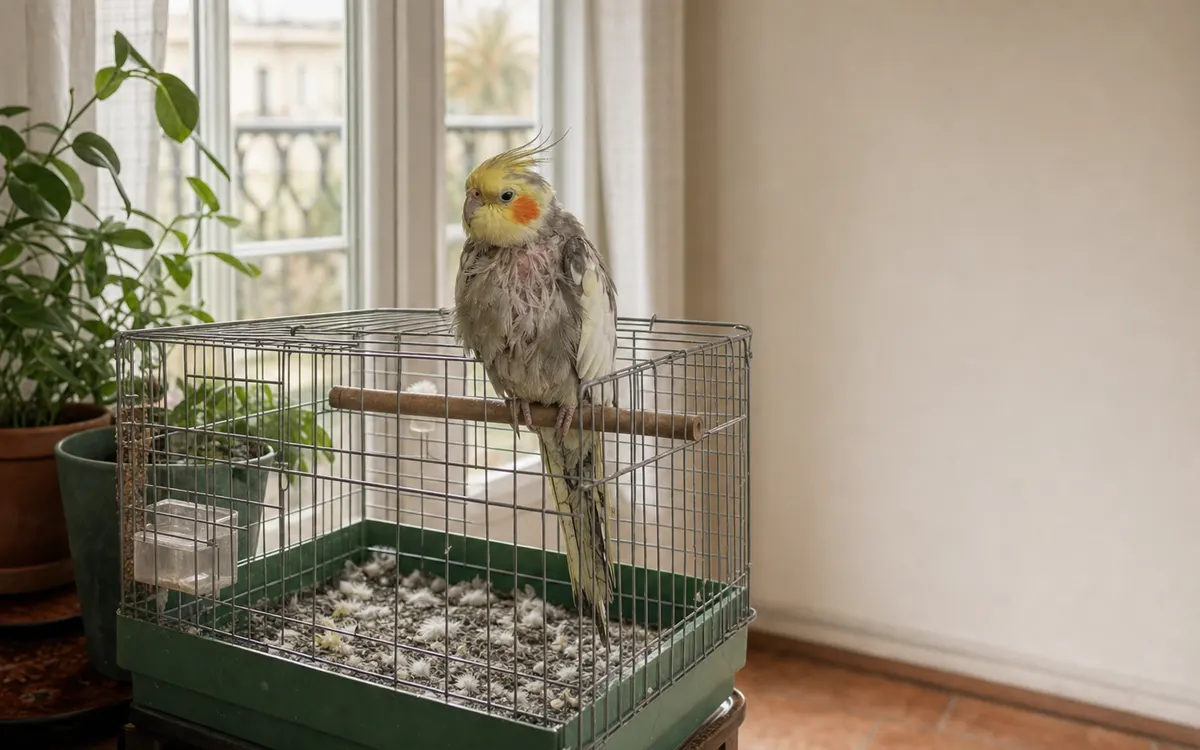
One day there are feathers on the cage floor, then more, and the bird that used to sing every morning has been quiet and grumpy for a week. The normal reaction is to worry. And the normal answer, in the vast majority of cases, is bird moulting: a physiological, expected and exhausting process.
The problem is that a moult looks quite a lot like two things that are not a moult, and confusing them costs months.
What Is Happening Inside
A feather is dead tissue. It does not repair itself: when it breaks or wears out, the only option is to drop it and build another. That is what a moult is.
Building new plumage is one of the most expensive things a bird’s body does. Feathers are almost entirely keratin, which means protein, and during those weeks protein requirements rise noticeably. That is why a moulting bird is quieter, sleeps more and can be irritable if handled: it is not annoyed, it is spending its energy budget elsewhere.
In a wild bird this happens in a specific window of the year, set by daylight hours and food availability. In a living room with artificial light until midnight and constant temperature, that signal blurs. That is why many pet birds moult slowly and all year round instead of doing it all at once in September. It is not a disease, but it helps to know so you do not panic in January.
What a Normal Moult Looks Like
Four features define a healthy moult:
It is symmetrical. If the third flight feather is missing on the right wing, the same one is usually missing on the left. The body keeps flight balance while it renews itself.
It leaves gaps, not bald patches. You will see skin between feathers, especially on the head and neck, but not wide, completely bare areas.
Pin feathers appear. Pin feathers are the new feathers wrapped in a keratin sheath before they open. On the head they look like little spikes and give the bird that characteristic scruffy look. Their presence is the best sign the moult is working: feathers are being lost and replaced at the same time.
The bird keeps eating. It may eat differently, looking for more protein or more greens, but it eats.
The Three Patterns That Are Not a Moult
This is where it pays to look carefully, because all three get mistaken for a moult and none of them resolves on its own.
1. Feather Plucking
The bird pulls its own feathers out. It is the number one behavioural complaint in companion birds and it is almost never a skin problem to begin with: it is behaviour.
How to tell: the bare areas are exactly where the beak reaches. Chest, flanks, legs, the inside of the wings. The head, by contrast, looks perfect, because the bird cannot reach it. That contrast is the signature of plucking. In a real moult the head is one of the first areas to thin out.
Behind it there is usually boredom, a lack of real sleep hours, a cage with nothing to do, a change at home or prolonged loneliness. It is a long subject and deserves its own article, but the urgent part is not to lose months assuming it is a moult.
2. French Moult and Follicle Problems
Especially in young budgies, flight and tail feathers fall out constantly or grow deformed, with a twisted shaft or with blood. The bird never flies properly and never finishes getting dressed. This is not a normal cycle and needs a veterinary diagnosis, because there are infectious causes behind it.
3. Feather Loss From General Illness
A bird with a liver problem, with parasites or on a poor diet loses plumage and does not replace it. The difference from a moult is that there are no new pin feathers. Feathers drop and nothing comes through behind them. If you have spent weeks seeing feathers on the floor and no area with new spikes coming up, that is not a slow moult: the process has stalled.
What Your Bird Needs During Those Weeks
More protein, genuinely. A seed mix on its own falls short exactly when it matters most. Mashed hard-boiled egg a couple of times a week, a good commercial rearing food, cooked unsalted pulses in the species that accept them. In parrots, a little more healthy fat too.
Sulphur amino acids. Keratin depends mainly on methionine and cysteine. Nothing exotic is needed: egg covers them well. Commercial moulting preparations work, but read them, because many are sugar with colouring.
Baths. A moulting bird appreciates getting wet far more than usual: water softens the sheaths of the pin feathers and eases the itch. A wide shallow dish, a mister with lukewarm water sprayed from a distance, or time near the steam of the shower away from draughts. Two or three times a week as a minimum.
Real darkness. Ten to twelve hours of true night, with no television on beside the cage and no hallway light. It is the most neglected variable and the one that most affects both moult rhythm and plucking.
Less handling. Pin feathers carry blood while they grow and hurt when touched. A bird that normally accepts being stroked may nip during a moult, and that is not a setback in your relationship: it is pain. Reduce physical contact for those weeks and pick it up again afterwards.
Stable temperature. Incomplete plumage insulates worse. Avoid draughts and sudden changes, especially if the moult lands in mid-autumn.
What Not to Do
Do not pull pin feathers, not even the ones that look ready: if they bleed, a small bird can lose a dangerous amount in a short time. Do not add vitamin supplements to drinking water as a routine, because they spoil the water and the dose becomes impossible to control. And do not read “the bird is in a bad mood” as a behaviour problem to correct: it is tiredness, and it passes.
When to Call the Vet
Wide bare skin, feathers always broken in the areas the beak can reach, blood, weight loss, lethargy that does not improve, open-beak breathing at rest, or three months of loss with no visible new feathers. With birds it is also worth going sooner than with other animals: they hide illness by instinct until they no longer can, so by the time it shows, it has usually been going on a while.
A moult is uncomfortable for the bird and worrying for the person looking after it, but it ends. The other things do not end on their own, and that is why it is worth working out what is actually happening rather than waiting to see.