
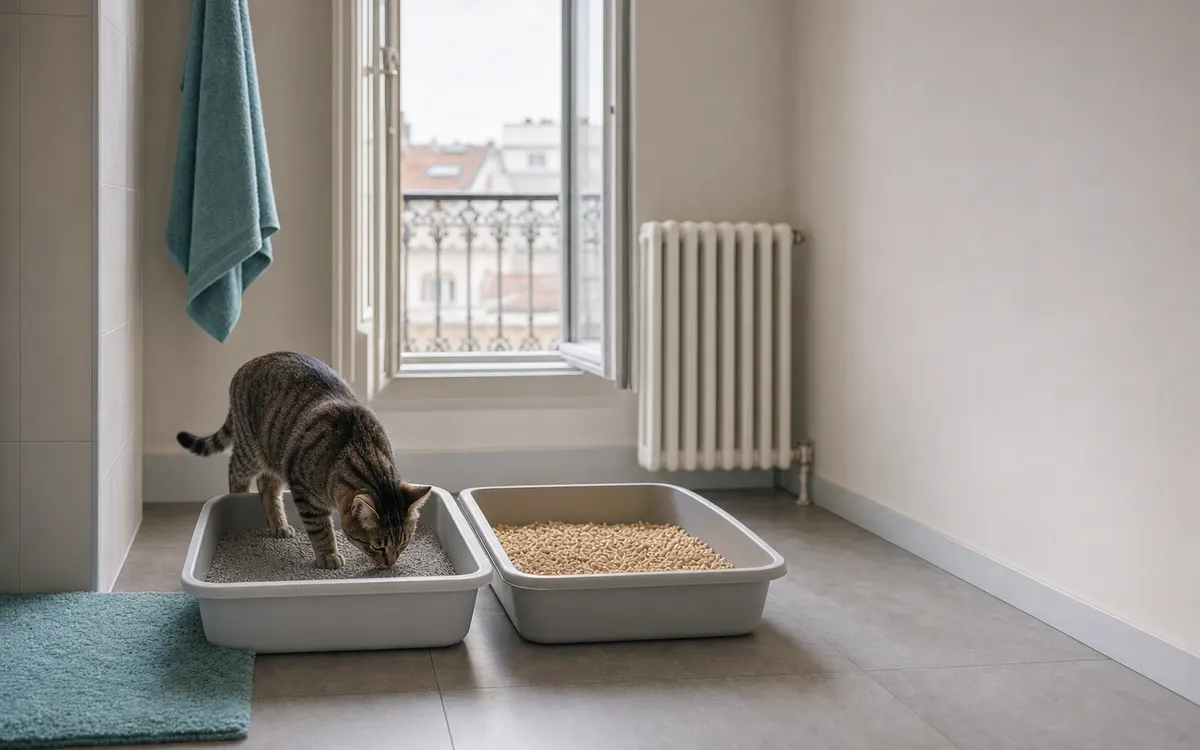
Searching for the best cat litter quickly turns into a contest of opinions: every manufacturer claims to be the best and every forum recommends something else. The useful way to decide is not to compare brands but to compare the four factors that actually change daily life:
- Odour control.
- Texture underfoot, which decides whether your cat uses it at all.
- How much ends up outside the tray.
- Real monthly cost, not the price per bag.
With those in hand, the five types on the market sort themselves out.
Clumping Bentonite
The most widespread. It forms solid clumps with urine that you scoop out whole.
- For: the best odour control of the group, because you remove the whole waste every day. Fine texture, which is what almost all cats prefer. Very quick daily cleaning.
- Against: heavy to carry, it creates dust (relevant if the cat or anyone at home has respiratory issues), and it sticks to paws, so it is among the worst for tracking onto the floor.
Silica or Crystals
Transparent beads that absorb moisture and let urine evaporate.
- For: lasts far longer than the others, barely smells for the first weeks and creates no dust.
- Against: the texture is hard and quite alien to what a cat looks for; some cats reject it outright. And because it does not clump, you cannot see the volume or appearance of the urine, which is clinical information worth having in plain sight.
Plant-Based (Corn, Wheat, Pea)
- For: light to carry, biodegradable in many cases, low dust and reasonable clumping.
- Against: odour control slightly below bentonite, and it can go pasty if it gets too wet. Usually more expensive.
Compressed Wood Pellets
- For: cheap, natural wood smell, very low dust and lightweight.
- Against: pellets are large and hard underfoot, so some cats will not accept them. As they break down into sawdust, cleaning works differently and needs a suitable tray.
Classic Non-Clumping Absorbent
- For: the cheapest on the shelf.
- Against: you cannot remove waste whole, so odour builds up and the whole tray has to be changed very frequently. Over a month it stops being that cheap.
What Really Decides It: Your Cat’s Opinion
Here is one finding that saves a lot of grief: when offered several trays with different litters, most cats prefer fine grains, sand-like texture and no fragrance. It fits their origins: burying in loose substrate is natural behaviour, and a hard surface or a strong smell interferes with it.
That is why scented litter, which we buy with our own nose in mind, is one of the most common reasons a cat starts going elsewhere. Our sense of smell appreciates the fragrance; theirs, which is vastly more sensitive, endures it.
How to Switch Litter Without Causing Refusal
Never all at once. The method that works:
- Mix 25% new litter with the old one for three or four days.
- If they use it normally, move to 50%.
- Keep increasing every few days until you reach 100%.
- If at any point they start avoiding the tray, go back to the previous proportion and slow down.
And an important warning: if your cat stops using the tray and going back to the old litter does not fix it, stop treating it as a preference problem. Urinating outside can signal cystitis, a blockage or another urinary problem, which in male cats is a genuine emergency. That is a call to the vet, not a trip to try another brand.
The Factors That Matter More Than the Litter
Many problems blamed on litter are really tray problems:
- Depth: five to seven centimetres. Any less and they cannot dig.
- Number: one per cat plus one, in different places. Two side by side count as one.
- Location: away from the food bowl, no sudden noise nearby, no risk of being cornered.
- Cleaning: scoop daily. It controls odour far more than the type of litter does.
- Hood: it traps odour for us and concentrates it for them. Some cats do not mind, others refuse.
In Short
If you want a starting recommendation: fine-grained clumping litter, unscented, scooped daily. It balances the four factors best and is the one most cats accept without trouble.
From there, adjust to whatever bothers you most: if it is dust, try plant-based; if it is weight or how often you change it, crystals; if it is price, wood, as long as your cat accepts pellets.
In the end, the best cat litter has a simple definition: the one your cat uses without hesitating and you can keep clean every day without it feeling like a chore.