
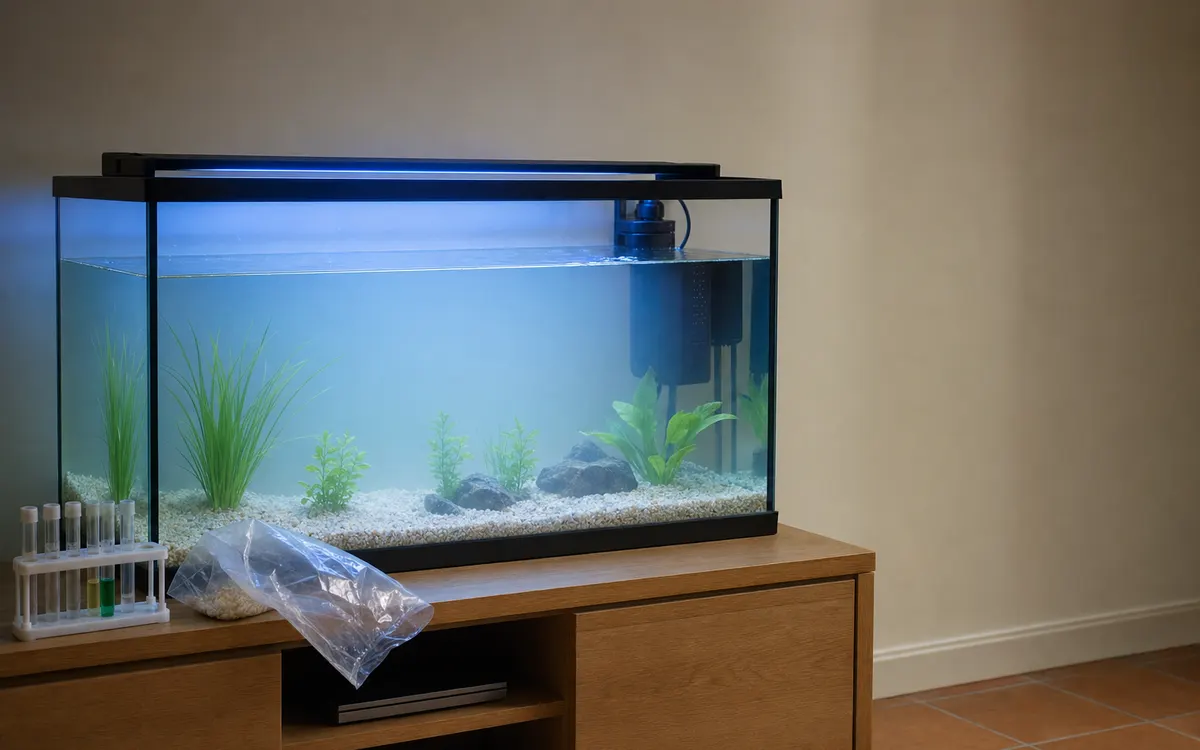
You set the tank up on a Saturday morning. You add the substrate, fill it with water, switch the filter on, and within a few hours the water looks crystal clear. The temptation is obvious: go to the shop that same afternoon and come back with fish. It is the most expensive and most common beginner mistake, and the reason many people conclude that “fish just die quickly” and give up.
Clear water is not safe water. What is missing is what you cannot see, and putting it there is what aquarium cycling means.
What Aquarium Cycling Actually Does in Those Weeks
An aquarium works because a colony of bacteria lives in the filter and the substrate, processing the waste the fish produce. That colony does not come in the box: it has to be grown, and it takes time.
The process is called the nitrogen cycle and it has three stages:
- Fish and leftover food produce ammonia. It is highly toxic: even low concentrations damage their gills.
- A first group of bacteria turns it into nitrite. Also toxic, almost as much as ammonia.
- A second group turns nitrite into nitrate, far less harmful, which you remove with water changes.
Each group takes weeks to multiply enough. Adding fish before they exist means ammonia builds up with nobody to process it, and the animal is in there while it happens.
How to Cycle Without Fish, Step by Step
It is easier than it sounds and only asks for patience:
- Set the tank up completely: substrate, filter, heater, and plants if you plan to have them. Leave it running around the clock.
- Add a source of ammonia. Either pure ammonia with no perfumes or surfactants, or a pinch of fish food left to break down.
- Measure every two or three days with a liquid test kit. You will see ammonia rise, then fall as nitrite rises, and finally nitrite fall as nitrate appears.
- When ammonia and nitrite both read zero twenty-four hours after a dose, the cycle is closed.
- Do a generous water change to bring the accumulated nitrate down, and start adding fish gradually.
That “gradually” in the last step matters as much as the rest: the bacterial colony sizes itself to the load it receives. Put fifteen fish at once into a tank cycled for three, and you get a fresh ammonia spike.
How to Genuinely Speed It Up
There is one shortcut that really works, and it is not a product: filter media from an established tank. A handful of used sponge, some ceramic media, or even a scoop of substrate from a healthy tank brings the colony ready-made. With that, the cycle can close in ten to fifteen days instead of six weeks.
If you know somebody with an aquarium, ask them. A good local fish shop will sometimes give you some too.
What helps less than it promises is bottled bacteria. They are not a scam, but their effectiveness depends on the brand and on how long the bottle sat on the shelf. Use them as a push, never as a substitute for measuring.
Mistakes That Drag the Cycle Out
- Cleaning the filter during the process. That is exactly where the colony you are growing lives. Leave it alone.
- Using untreated tap water with chlorine or chloramine: it kills the bacteria you are trying to cultivate.
- Constant water changes because “it looks cloudy”. That initial bacterial bloom is normal and clears on its own.
- Trusting test strips. They are imprecise in exactly the low ranges that matter. A liquid kit costs a little more and actually measures.
- Measuring only once. The cycle is a curve, not a yes or no: you need to watch each value rise and fall.
Why the Wait Is Worth It
A properly cycled aquarium is stable for years and asks very little: partial water changes, measured feeding, and not much else. A badly started one gives constant problems, deaths you cannot explain, and the feeling of always putting out fires.
It is three weeks of waiting at the start of a tank that can last a decade. It is probably the best effort-to-result ratio in the whole hobby, and the only part of the process you cannot buy ready-made.